







































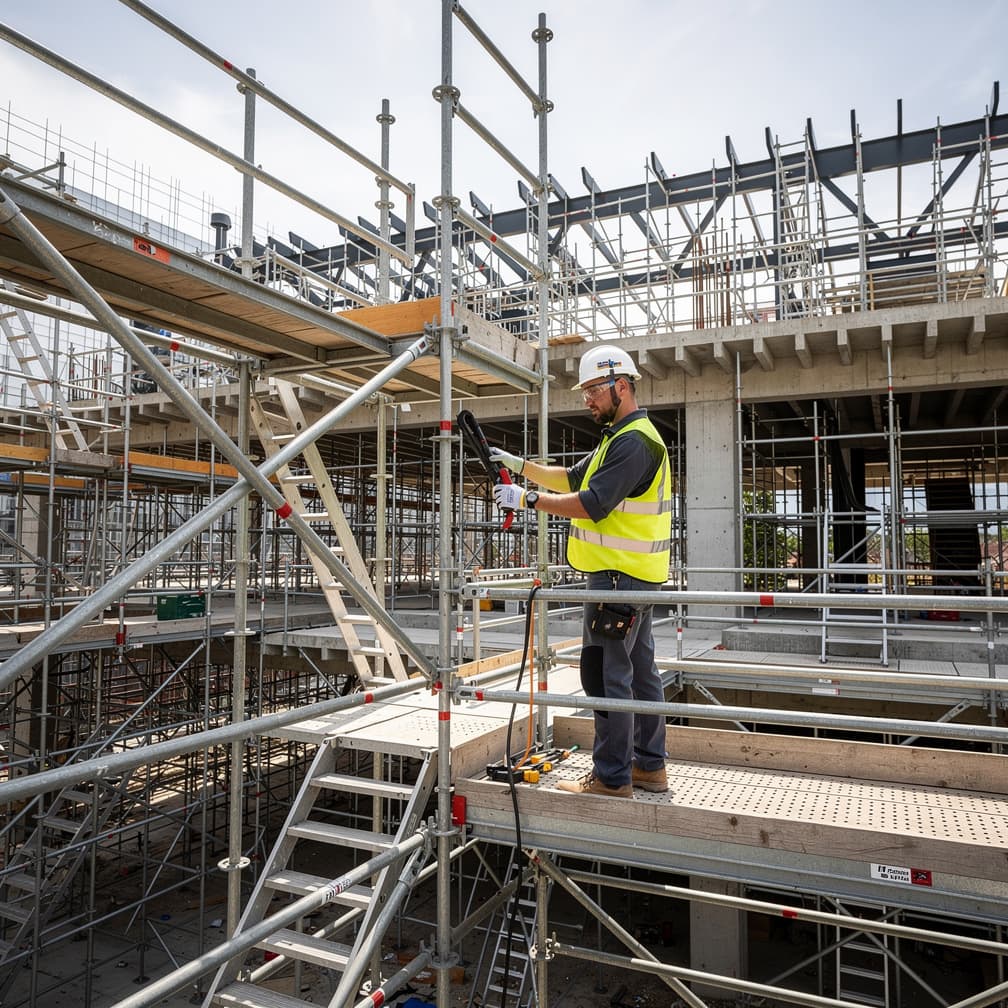

Guardrails come off when another trade needs an opening, and they do not always go back on before someone steps out onto the deck. The fall that follows is your claim even though your crew never touched the rail. Scaffolding company insurance in Round Rock starts from that fact and works outward to the injured bystander, the damaged facade, and the truck hauling braces at dawn. Workers Compensation pricing runs off payroll and class code, so your rate moves with your crew, your loss record, and how honestly the payroll gets split between yard work and work at height. Contract limits arrive separately and rarely bend. What follows sets out both sides, so a Round Rock bid can carry its real insurance cost instead of a guess.
What Makes Round Rock Different
Loss history is the lever with the longest memory, and in this trade the losses are falls. One serious fall claim on a Round Rock job can shadow your pricing for years, long after the crew involved has moved on. What you do between claims is what changes the next quote: documented inspections, competent-person sign-offs, a tag system nobody bypasses. Carriers reward evidence rather than intentions, so the file you hand over is the whole argument you get to make. Deductible choice is the other lever, and lifting it lowers the premium by moving risk back onto your own account. That trade only makes sense if the deductible is a number you could write a check for in a slow month. Payroll and receipts set the base; your record sets the multiplier on top of it. Both belong on the table before you compare a Round Rock quote to anything.
Local Risk Factors in Round Rock
Severe storms arrive faster than a crew can dismantle, and that gap is the whole problem for an erector. A squall line can put a standing frame under gusts nobody planned for while your crew is still driving home from a Round Rock site. What falls is rarely the scaffold itself; it is a plank, a coupler, or a length of netting, and it lands on whatever happens to be below. That third-party moment is what General Liability generally exists for, and the questions afterward are about ties, spacing, and whether the deck was secured. Photographs taken before the storm are worth more than any argument made after one in Texas.
What Coverage Does a Scaffolding Company in Round Rock Need?
General Liability
Every general contractor and building owner who lets your frames onto a site asks for this one by name. General Liability aims at the people who are not your employees: the passerby struck by a dropped coupler, the mason who slips on your deck, the storefront damaged when a section comes down. Repairing your own faulty work typically sits outside it.
Example: A brace slips during dismantle and cracks the windshield of a parked car below; the owner's claim for the glass and the paintwork is the kind of loss this line is meant to answer.
Workers Compensation
Falls define this trade, and this is the line that deals with the people who fall. Workers Compensation is built around wage replacement and medical costs for your own crew, priced per hundred dollars of payroll and rated by class code. It does not answer for an injured passerby, and uninsured helpers can land on your audit as payroll.
Example: An erector's foot goes through an unsecured plank on a Round Rock facade job and he lands on the deck below; the wage and medical side of that injury is what this coverage typically handles.
Tools & Equipment (Inland Marine)
Your declarations page lists an address; your frames spend the year everywhere else. Inland Marine follows scheduled equipment in transit, at a job site, or stacked in the yard: frames, planks, braces, screw jacks, couplers. It can often be extended to scaffold you rent or lease and owe money on. Wear, rust, and gradual deterioration are usually excluded.
Example: A trailer is stripped overnight and a full load of decking is gone before the crew arrives; a sudden equipment loss like that is generally where this cover earns its keep.
Commercial Auto
Where Inland Marine watches the steel, Commercial Auto watches the truck hauling it. This line deals with the vehicles moving frames and crews between jobs: the accident you cause, the injuries and damage that follow, and, under comprehensive terms, hail or theft to the trucks themselves. Personal policies generally exclude business use, so a family pickup on a job run is a gap.
Example: A stack of braces shifts on a highway ramp and the trailer clips a sedan; the injury claim and the repair bill are the sort of thing this line is intended to take on.
Commercial Umbrella
When a contract demands a total your primary limit cannot reach, this is usually the cheaper route to it. Commercial Umbrella sits above the liability limits you already bought and can extend them once the underlying policy is exhausted. It generally follows only the policies named as underlying, so a gap below becomes a gap above too.
Example: A collapse injures two people and damages a Round Rock storefront, and the settlement runs past the primary liability limit; the excess layer is what a total like that is meant to reach.
How Much Does Scaffolding Company Insurance Cost in Round Rock?
Scaffolding Company Insurance is a bundle of separate policies, priced separately. The ranges below are typical figures for Round Rock for each line, except workers compensation, which is rated per $100 of payroll; a quote prices each one against your own operations.
| Coverage | Typical range | What moves your price |
|---|---|---|
| General Liability Insurance | $850 - $2,600 per month | Industry and risk classification, annual revenue, number of employees |
| Workers Compensation Insurance | $0.75 - $2.74 per $100 of payroll | Employee classification codes, total annual payroll, experience modification rate |
| Inland Marine Insurance | $150 - $625 per month | Total insured value of the scheduled property, type and age of the equipment, where it is stored and how far it travels |
| Commercial Auto Insurance | $430 - $1,275 per month | Fleet size and vehicle types, driver records and experience, coverage limits and deductibles |
| Commercial Umbrella Insurance | $250 - $1,075 per month | Umbrella limit requested, limits carried on the underlying policies, loss history on those underlying policies |
Prices shown are general estimates, not guaranteed rates or quotes. Your actual premium will depend on the insurer, coverage selected, business details, location, claims history, and other underwriting factors.
What Are the Insurance Requirements for a Scaffolding Company in Round Rock?
Workers' comp is not mandatory for most private employers here. Texas leaves workers' compensation optional for most private employers. Skipping it leaves injury costs on you, and many clients and general contractors still demand proof of it by contract — check the Texas Department of Insurance's guidance before deciding.
State auto liability minimums apply to business vehicles. Texas's minimum auto liability limits are $30,000/$60,000/$25,000 (bodily injury per person / per accident / property damage). Contracts and lenders often require more than the state floor.
Where to verify licensing and coverage rules. The Texas Department of Insurance publishes consumer guidance and current insurance requirements for Texas businesses. When a contract or lease demands specific wording, the Texas Department of Insurance's guidance is the authoritative place to check.
Get Your Scaffolding Company Quote in Round Rock
Compare rates from multiple carriers. Free quotes, no obligation.
Operating in Round Rock
- The customer who erects your rented gear themselves still calls you when it comes down, and your name on the delivery ticket is what puts you in the conversation.
- Insurance requirements travel with the work: a Round Rock contract and one an hour away in Texas can name different limits and different endorsements for identical scaffold.
- A claim landing in your busiest month costs twice, once in the settlement and once in the calendar you lose to inspections, statements, and photographs.
- Gate access on a commercial site depends on paperwork rather than on your truck: an expired certificate sitting in a compliance system locks the crew out before anyone reads your name.
How to Buy: Advice for Round Rock Owners
Read the number your contract demands, then read your declarations page. Contracts frequently ask for a total a primary General Liability limit cannot reach alone, and a Commercial Umbrella layer is usually the cheaper route to it. Ask whether the umbrella sits over the auto and employer's liability pieces too, because a scaffolding claim rarely stays inside one policy. Confirm that the layer's underlying requirements match the primary you actually bought, since a mismatch there turns the extra limit into decoration. Bring the contract's schedule of insurance to the conversation and let the carrier say what satisfies it. The Texas Department of Insurance publishes consumer guidance on how excess layers work, which is worth one careful read. When you shop, ask participating carriers to quote the primary and the layer together for your Round Rock operation rather than separately.
FAQ
Scaffolding Company Insurance in Round Rock: FAQ
That question splits in two. Commercial Auto is generally aimed at the vehicle and the harm it does; the frames and planks riding behind it are property, and property is where an Inland Marine form usually comes in. A load that shifts and injures another driver can pull both into a single claim. Ask each quote which piece answers for the steel itself.
The argument starts with your records. A Round Rock job that stands for a month after handover is a month of other trades cutting ties, moving guardrails, and stacking block on bays, and your inspection log and photographs are what separate a defensible file from a payable claim. Liability claims name everyone anyway, so the real question is who pays at the end.
Read the rental agreement first. It usually makes you answerable for damage whether or not anyone was careless, which is a contract obligation rather than a fault question. Inland Marine can often be extended to property in your care that you do not own, but generally only if it has been scheduled. Tell the carrier the value you are on the hook for.
The per-occurrence figure is what one collapse can reach. The aggregate is what an entire policy year can reach across every job you have standing. Contracts usually name the first and stay quiet about the second, because the drafter is thinking about one site. An erector with work standing on three Round Rock sites has to think about both at once.
Often. Classify payroll accurately between yard work and work at height, keep the vehicle list current, raise a deductible you could genuinely fund in a slow month, and document the fall program you already run. Erectors who bring evidence get priced on evidence. Cutting a limit to save money is the change that reads worst on the day a claim lands.
Not the moment the truck pulls away. Claims arising from work you finished can arrive weeks later, and the wording that deals with them lives in your General Liability form rather than in a handshake. Keep the dismantle sign-off, the photographs, and the handover note. A collapse after your crew left is still your phone call, and the file is your answer.
Sources
- 1.Texas Department of Insurance(Texas Department of Insurance publishes consumer guidance for insurance buyers.)


