







































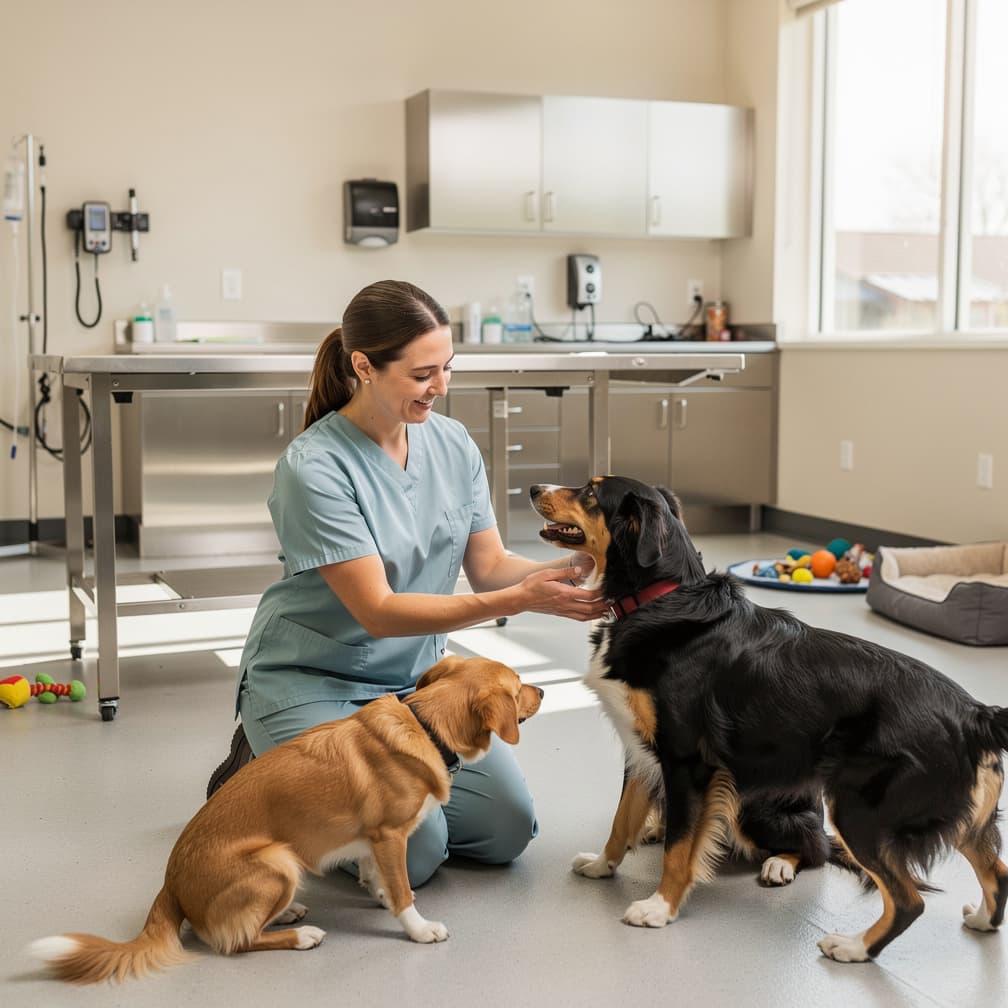

General liability for a doggy daycare typically runs from $35 to $130 a month, and the spread has less to do with your address than with how many dogs share a room. Doggy daycare insurance in Rutland gets priced off headcount, payroll, square footage, and the bite history you disclose. A facility in Rutland that separates dogs by size and temperament tends to look different to an underwriter than one running a single open floor. Claims history moves the number more than anything else, and it keeps moving it for years. If you have never had a claim, say so early in the quote process, because a clean record is worth real money at renewal. The breakdown below shows which coverages sit where in that range and what each one is meant to reach.
What Makes Rutland Different
Revenue per dog is thinner outside a metro, and the premium does not shrink to match. Rutland County has about 2,000 businesses, and a smaller client pool means fewer dogs paying the same fixed costs. Insurance is one of those fixed costs, sitting on the books whether the room is full or empty. The lever you own is the deductible, and it trades a lower monthly bill for real exposure. A higher deductible only makes sense if you could actually write that check next week. Facilities that pick a deductible they cannot fund end up paying small claims out of pocket. Then the claim never gets reported, and the loss run looks clean for the wrong reason. Pick the number your bank account can survive, then let the policy do its job.
Local Risk Factors in Rutland
Before the first cold snap, decide what happens to the dogs if your heat fails overnight. A kennel without heat is a welfare emergency rather than an inconvenience, and the answer cannot be improvised at five in the morning. Insulate the exposed lines, keep a thermometer with an alarm on it, and know which contractor in Rutland County answers a night call. On the policy side, a closure while the heat is repaired can be its own kind of loss, separate from the physical repair a property quote addresses. Ask what a Rutland quote says about days you cannot open, and ask what documentation it wants while the doors are shut.
What Coverage Does a Doggy Daycare in Rutland Need?
General Liability
Landlords, lenders, and corporate clients ask for this line by name before you open, and it is generally the one aimed at claims from the people and dogs who are not yours: a parent who falls in the lobby, a passerby hurt by an escaped boarder. Injuries to your own staff belong on a payroll policy instead, and animals in your custody are often limited by separate wording worth reading.
Example: Two boarders tangle over a toy during afternoon play and one needs surgery; the owner's demand and an attorney's letter arrive together, and general liability can help cover the defense.
Commercial Property
Wear and tear on your dryers is your own problem; a fire that starts in one is a different question. This line generally addresses sudden accidental damage to your building, improvements, crates, gates, play structures, laundry equipment, and the office computer. Standard forms typically exclude flood and gradual breakdown, and the income you lose while the doors are shut is usually a separate part of the quote.
Example: A storm peels back a section of roof over the play room in Rutland, soaking bedding and shorting the ventilation; commercial property may respond to the repairs and the ruined contents.
Professional Liability
Judgment is a product a daycare sells: which dogs play together, which medication gets given, whether a temperament test happens on a busy morning. When an owner argues that a decision, rather than an accident, hurt their dog, this is the line built for that argument. It typically does nothing for a customer who slips in your lobby, which sits with your liability policy instead.
Example: You pair a nervous rescue with a rough play group after a rushed intake and the dog is injured; the owner's claim about that call is what professional liability is meant to reach.
Workers Compensation
Client claims and staff claims are different animals, and this is the staff side. Handlers get bitten separating dogs, wrench shoulders lifting a big boarder into a tub, and slip on hosed floors, and this line generally addresses their medical care and lost wages. Requirements for employees vary by state, and rating runs on payroll rather than on headcount.
Example: A handler's hand is bitten breaking up a scuffle and the repair costs weeks of restricted duty; workers compensation could take on the medical bills and part of the missed pay.
How Much Does Doggy Daycare Insurance Cost in Rutland?
Doggy Daycare Insurance is a bundle of separate policies, priced separately. The ranges below are typical figures for Rutland for each line, except workers compensation, which is rated per $100 of payroll; a quote prices each one against your own operations.
| Coverage | Typical range | What moves your price |
|---|---|---|
| General Liability Insurance | $120 - $440 per month | Industry and risk classification, annual revenue, number of employees |
| Commercial Property Insurance | $100 - $350 per month | Building value and construction type, roof age and condition, fire protection class |
| Professional Liability Insurance | $60 - $210 per month | The services you actually perform, annual revenue or billed fees, limit and retention selected |
| Workers Compensation Insurance | $0.75 - $2.74 per $100 of payroll | Employee classification codes, total annual payroll, experience modification rate |
Prices shown are general estimates, not guaranteed rates or quotes. Your actual premium will depend on the insurer, coverage selected, business details, location, claims history, and other underwriting factors. Learn about our pricing methodology.
What Are the Insurance Requirements for a Doggy Daycare in Rutland?
Workers' comp is generally required once you have your first employee. Vermont generally requires employers to carry workers' compensation at that point. Common exemptions include sole proprietors, partners, and corporate officers. Confirm current thresholds with your state's workers' compensation agency before you hire.
Flood damage is typically excluded from standard policies. Standard commercial property and builders-risk-type policies typically exclude flood damage. Flood exposure varies address by address, so check your premises in FEMA's Flood Map Service Center before deciding; if you sit in a mapped flood zone, a separate policy through the National Flood Insurance Program is the usual starting point.
Where to verify licensing and coverage rules. The Vermont Department of Financial Regulation publishes consumer guidance and current insurance requirements for Vermont businesses. When a contract or lease demands specific wording, the Vermont Department of Financial Regulation's guidance is the authoritative place to check.
Get Your Doggy Daycare Quote in Rutland
Compare rates from multiple carriers. Free quotes, no obligation.
Operating in Rutland
- Group play rules exist for the claim you never get. A facility that separates by size and temperament has a shorter conversation with an underwriter than one running a single open floor.
- Your washer and dryer run more hours in a week than a household pair runs in a year, and no policy takes wear and tear off your hands.
- A corporate client in Rutland can send a vendor packet demanding wording your current policy does not carry, and the deal often depends on producing it within days.
- Handlers get hurt more than clients do. A bite to the hand during a separation is the claim that most often turns into restricted duty and a payroll file.
How to Buy: Advice for Rutland Owners
Gather the numbers before you shop, because every carrier asks for the same ones and inconsistent answers slow everything down. You need annual revenue, total payroll by role, square footage of your Rutland facility, average dogs per day, maximum dogs per day, and the number of handlers on the floor at peak. Add your loss run for the last three to five years, even if it is empty, since an empty one is worth saying out loud. Note whether you accept intact dogs, whether you board overnight, and whether you groom or train on site, because each answer changes underwriting appetite. Workers compensation quotes hinge on the payroll split, and general liability hinges on the headcount and ratio. The Vermont Department of Financial Regulation publishes consumer guidance on how business insurance quotes are put together. CPK then lines up participating carriers against that single set of facts.
FAQ
Doggy Daycare Insurance in Rutland: FAQ
Standard commercial property forms typically exclude flood, meaning water that rises from the ground outside. A burst supply line inside the building is a different question and is often treated apart from flood. Flood gets priced as its own decision, and a yard that pools every heavy rain is worth mentioning to whoever quotes you. Check what the form says about surface water before assuming either way.
A signed waiver at intake does not stop a lawsuit; it shapes the argument. Clients bring claims after a bad outcome, and the defense costs money whether the claim has merit or not. Liability coverage is generally where the defense of that claim starts, and defense expenses can sit inside or outside your limit depending on the form. Ask which arrangement your quote uses.
Expect questions about annual revenue, payroll by role, square footage, average and maximum dogs per day, handlers on the floor at peak, breeds accepted, whether you take intact dogs, and whether you board overnight or groom. A loss run for the last few years rounds it out. Answering consistently across carriers is what makes the quotes comparable at the end.
No. Wear and tear, gradual breakdown, and maintenance are excluded from property forms by design; insurance is built for sudden, accidental loss. A fire that starts in the same dryer is a different story entirely. Ask whoever quotes you what the form says about mechanical breakdown, since answers differ between carriers and your machines run all day. Budget for replacement separately from your premium.
More than almost anything else you control. Two bite claims in three years reads to an underwriter as a pattern rather than bad luck, and the effect lingers across several renewals. A clean loss run is an asset, so ask for a copy before you shop your Rutland renewal and hand it over early. Paying small claims quietly to protect the run has its own cost, since the underlying issue stays.
That is an argument about your judgment rather than about an accident, so professional liability is generally the line aimed at it. General liability is built for the physical event: the fall, the scuffle nobody could foresee, the damage. Facilities that offer training or administer medication carry more of the judgment exposure than they think. Owners often buy one line and assume it contains the other, which is worth checking in your own policy.
Sources
- 1.U.S. Census Bureau, County Business Patterns (2022), Rutland County(Rutland County has about 2,000 business establishments.)
- 2.Vermont Department of Financial Regulation(Vermont Department of Financial Regulation publishes consumer guidance for insurance buyers.)
- 3.FEMA / FloodSmart(Flood coverage is typically purchased separately; FEMA administers the National Flood Insurance Program.)


