







































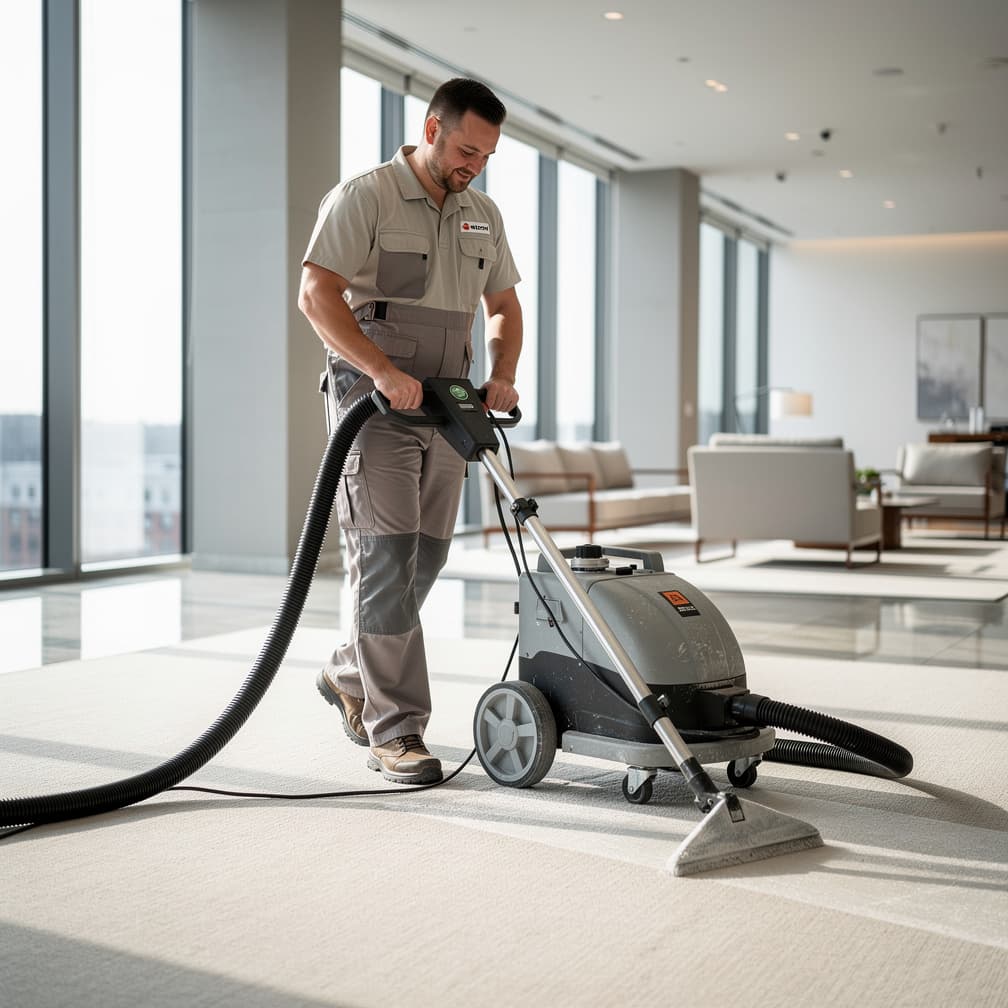

King County has about 70,500 businesses, and each one that hires a cleaner brings its own idea of what your paperwork should say. That is the practical difference a big market makes: the work is real, and so is the compliance queue standing in front of it. Carpet cleaning insurance in Bellevue gets bought twice by people who skip that step, once cheaply and once again when a vendor portal rejects the certificate. Meanwhile the risk itself never moved. A guest still trips over a hose, a rug still browns, an air mover still knocks a chip out of trim. Buy for the damage you can actually cause, then check that the limits clear the portals you want to sell into.
What Makes Bellevue Different
Payroll is the lever for a Bellevue cleaner, and it moves more of the bill than anything else you control. Every helper on the truck adds hours of exposure to hot water, heavy machines, and other people's stairs. Rating follows those hours, which is why two shops with identical revenue can be quoted very differently. Vehicles are the second lever, and mileage is the part owners forget to report honestly. In a metro the time between jobs is traffic rather than distance, and the meter runs either way. Equipment values come third: a truck-mount moves the number, a portable extractor barely registers. None of these are negotiated, they are reported, and a sloppy report becomes a claim problem later. Give the same figures to every Bellevue quote you pull and the comparison finally means something.
Local Risk Factors in Bellevue
Wildfire reaches this trade through smoke and through the phone. Smoke damage is work for a cleaner, and it is work with a promise attached: getting odor out of a carpet is not something anyone can promise, and the customer's expectation becomes your exposure. Say what the process can and cannot do, in writing, before the first pass. Evacuation orders are the other half, since a closed area means no jobs, no revenue, and payroll that does not pause politely. Commercial Property may respond to fire damage at your own shop, subject to the deductible you picked. Ask what happens when a Bellevue building is standing but unusable, because Washington smoke can shut a place down without ever burning it.
What Coverage Does a Carpet Cleaning in Bellevue Need?
General Liability
A guest goes down on a wet landing while your hoses are still running: that is the loss this line exists for. General Liability generally addresses injury to other people and damage to a customer's property caused by your work, along with the lawyer who arrives afterward. Buildings ask for it by name. Wear on old fiber, and a result a customer simply dislikes, typically sit outside it.
Example: An air mover parked against a baseboard chews through the trim overnight and the homeowner wants the whole run replaced; general liability may pick up the repair once the deductible is met.
Commercial Auto
Personal auto forms generally exclude business use, which leaves the van you load with an extractor, hoses, and forty gallons of solution unaccounted for. Commercial Auto is written for that vehicle: the collision, the injury claim from the car you hit, and often the theft of the truck itself. What rides in the back can be a separate question, so ask where the equipment actually sits.
Example: A driver runs a light and folds the front of your van on the way to a morning job in Bellevue; commercial auto could answer for the vehicle and for the injury claim behind it.
Commercial Property
The shop, the bay, the shelves of solution, and the machines waiting for tomorrow are what this line watches. Commercial Property can respond to fire, theft, or a burst pipe at a location you schedule, and a landlord can require it in the lease before handing over keys. Rising water is not part of it and is bought separately.
Example: Somebody forces the roll-up door overnight and two extractors leave with them; commercial property, subject to the deductible you chose, is the line that tends to answer for the machines.
Workers Compensation
Where General Liability looks at the customer's guest, Workers Compensation looks at your own helper. It typically handles medical care and lost wages for an employee hurt on a job, from a back strained on a staircase to a hand burned on a hot line. Rates run against payroll, and the Washington Office of the Insurance Commissioner publishes the current requirements for Washington.
Example: A helper carrying an extractor down a wet staircase tears a knee and misses six weeks; workers compensation is generally the line meant to cover the medical bills and part of the lost pay.
How Much Does Carpet Cleaning Insurance Cost in Bellevue?
Carpet Cleaning Insurance is a bundle of separate policies, priced separately. The ranges below are typical figures for Bellevue for each line, except workers compensation, which is set by the state fund; a quote prices each one against your own operations.
| Coverage | Typical range | What moves your price |
|---|---|---|
| General Liability Insurance | $60 - $180 per month | Industry and risk classification, annual revenue, number of employees |
| Commercial Auto Insurance | $200 - $525 per month | Fleet size and vehicle types, driver records and experience, coverage limits and deductibles |
| Commercial Property Insurance | $80 - $270 per month | Building value and construction type, roof age and condition, fire protection class |
| Workers Compensation Insurance | Set by the state fund | Employee classification codes, total annual payroll, experience modification rate |
Prices shown are general estimates, not guaranteed rates or quotes. Your actual premium will depend on the insurer, coverage selected, business details, location, claims history, and other underwriting factors. Learn about our pricing methodology.
What Are the Insurance Requirements for a Carpet Cleaning in Bellevue?
Workers' comp is generally required once you have your first employee, through the state fund. Washington runs workers' compensation through a state fund: employers buy coverage from the Washington State Department of Labor & Industries (L&I), not from private carriers. Common exemptions include sole proprietors and partners. Confirm current requirements directly with the fund before you hire.
State auto liability minimums apply to business vehicles. Washington's minimum auto liability limits are $25,000/$50,000/$10,000 (bodily injury per person / per accident / property damage). Contracts and lenders often require more than the state floor.
Flood damage is typically excluded from standard policies. Standard commercial property and builders-risk-type policies typically exclude flood damage. Flood exposure varies address by address, so check your premises in FEMA's Flood Map Service Center before deciding; if you sit in a mapped flood zone, a separate policy through the National Flood Insurance Program is the usual starting point.
Where to verify licensing and coverage rules. The Washington Office of the Insurance Commissioner publishes consumer guidance and current insurance requirements for Washington businesses. When a contract or lease demands specific wording, the Washington Office of the Insurance Commissioner's guidance is the authoritative place to check.
Get Your Carpet Cleaning Quote in Bellevue
Compare rates from multiple carriers. Free quotes, no obligation.
Operating in Bellevue
- Wool and silk are where the money is and where the claims are. One antique rug can be worth more than a month of Bellevue route revenue, and it sits on the floor looking like any other job.
- The customer's insurance company goes looking for someone to blame when a floor cups after a wet job, and the cleaner who was there last is the convenient answer, in Bellevue or anywhere else.
- Hoses run through a propped exterior door create two problems at once: a trip hazard for strangers walking past and an open building the owner never agreed to leave open.
- Spotting agents and pre-spray live in the van, and a jug that leaks across a customer's driveway or a lobby floor is property damage before it is a housekeeping chore.
How to Buy: Advice for Bellevue Owners
Certificates are the operational half of this purchase, and they matter on a schedule. Know who issues yours, how quickly they can send one, and what your policy already says, so an urgent request does not turn into an amendment. Every account that wants naming as an additional insured belongs on a list you keep, not in your memory. A building can freeze your start date until the document is on file, and a lapsed policy leaves a crew standing around on your payroll. General Liability is usually the line a certificate describes, though a building may also ask what Commercial Auto limits ride with the van on its dock. Check the Washington Office of the Insurance Commissioner's guidance before deciding what your proof of coverage should show. Then compare quotes from participating carriers on how the package reads in Bellevue, rather than on what the first line costs.
FAQ
Carpet Cleaning Insurance in Bellevue: FAQ
It depends on how the damage happened and what the form says. Sudden accidental damage to a customer's property is the kind of loss liability coverage is meant for, and it could respond once the deductible is met. Damage from a process you chose, on a fiber that could never take it, can look like faulty workmanship instead, and that is commonly excluded. Test the fiber, photograph the tags, and write down what you found before the wand comes out.
Property managers, building owners, facilities teams, and the occasional homeowner with an expensive floor. Each can ask for a certificate, and some want their company named as an additional insured, which gives them standing under your policy for claims arising from your work. A few also want notice before the policy can lapse. Ask any Bellevue account for its requirements in writing so the document says what they need the first time.
It is an endorsement that stretches some of your policy's protection to another party, usually the building or the management company that hired you. If a guest sues them over a fall near your air movers, the endorsement can put your insurer in the room instead of leaving them to answer alone. It does not raise your limits, it shares them. Buildings request it by habit, so ask before you price the job.
One is per event, the other is per policy year. If a guest falls near your hoses, the per-occurrence limit caps what that single claim can draw. The aggregate is the ceiling on everything paid across the year, so three bad jobs can eat it while each one stays well under the per-occurrence number. A cleaner with a string of small property-damage claims meets the aggregate first. Contracts often name both, so read which one they mean.
Usually not for simply wearing out. Breakdown from age, use, or a tired pump reads as maintenance, and policies typically exclude it. Coverage tends to follow sudden accidental causes instead: theft from the van, fire at the shop, a collision that destroys what was strapped in the back. Ask every quote precisely where your machines might be covered and at what value, since a shop policy and a vehicle policy can each point at the other.
Typically no. Personal auto forms generally exclude business use, and a van loaded with an extractor, hoses, and solution is business use by any reading. Commercial Auto is the line meant for that vehicle, and it is often the largest number a cleaner pays each month. The equipment inside is a separate conversation, so ask whether the vehicle policy speaks to the load or whether another form has to.
Sources
- 1.U.S. Census Bureau, County Business Patterns (2022), King County(King County has about 70,500 business establishments.)
- 2.Washington Office of the Insurance Commissioner(Washington Office of the Insurance Commissioner publishes consumer guidance for insurance buyers.)
- 3.FEMA / FloodSmart(Flood coverage is typically purchased separately; FEMA administers the National Flood Insurance Program.)


