







































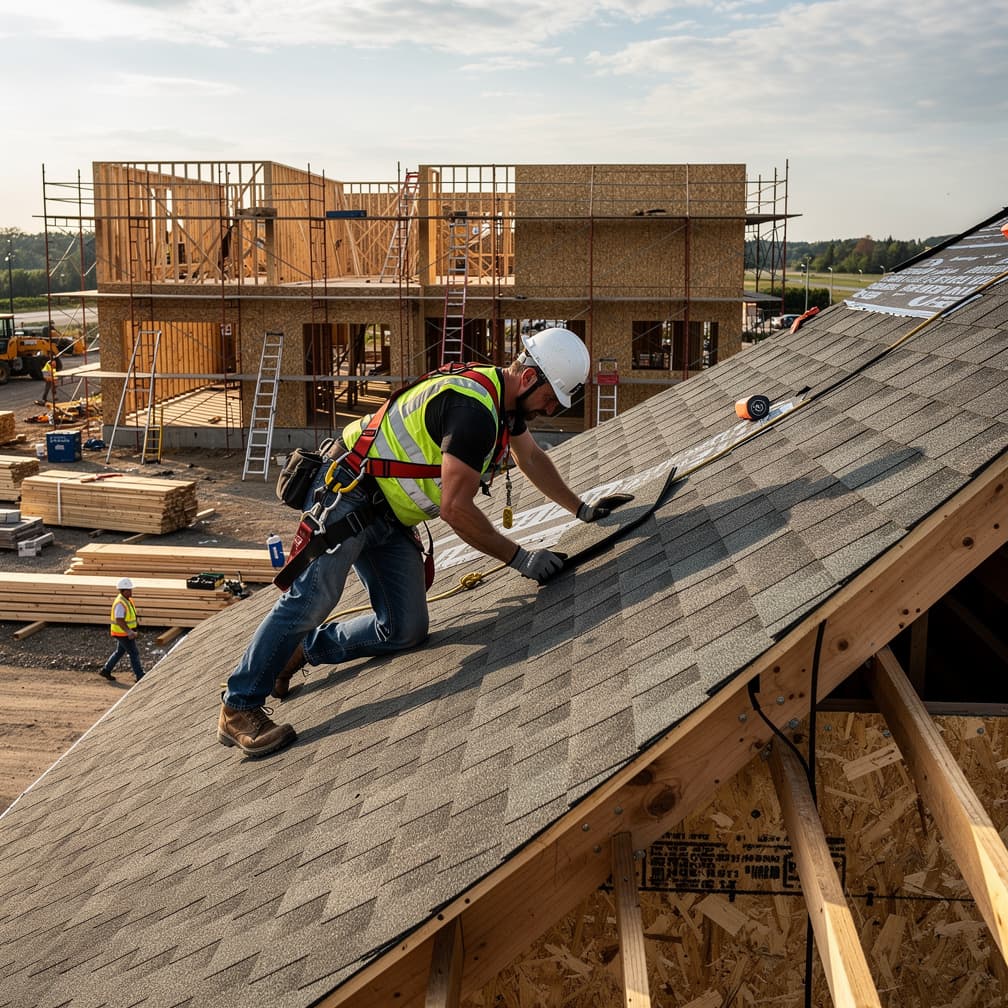

Ladders slip. That fall is the loss that reshapes a roofing payroll rate for years, and it starts a same-day argument about whether the injured man was your employee or a sub's. Medical bills and lost wages do not wait for that argument to finish. Workers Compensation is where it lands, and the price rides on payroll and job classification rather than on how careful your best foreman is. King County holds about 70,500 business establishments, and every commercial roof among them belongs to somebody with a contract template and a certificate deadline. Roofing insurance in Bellevue gets tested by that paperwork long before it is tested by a claim. Begin with what your signed contracts already obligate you to carry, then go price it.
What Makes Bellevue Different
About 200 roofing contractors work the market around Bellevue, which is a deep bench of crews and an even deeper bench of subs. Subcontracting is what that depth produces: overflow moves sideways between outfits during any busy stretch of the year. Every sub you use is either insured on their own paper or charged back onto yours at audit time. Collecting certificates from subs is unglamorous administration that decides what your premium looks like at year end. A crowded market also means the injured worker on your job may be somebody you never hired directly. That is the claim that gets complicated, and it is the reason your limits deserve a second look. Ask any quote how subcontracted labor is rated and what proof it expects you to hold. Depth of market is a payroll question wearing a marketing costume.
Local Risk Factors in Bellevue
Before you take work in a fire-prone area, look at the drive as hard as you look at the roof. Road closures strand crews and trucks, and highways in heavy smoke are where Commercial Auto claims come from. Vehicle deductibles are the number to check, since a fleet loss is several deductibles rather than one. Carriers in Washington may add conditions or pause new coverage during active fire periods, so timing your shopping matters more here than anywhere else. Your crew in Bellevue also has an air-quality limit, and pushing them past it is a decision you own. Check the Washington Office of the Insurance Commissioner's guidance before deciding how to plan for a fire season.
What Coverage Does a Roofing in Bellevue Need?
General Liability
Owners, general contractors, and permit desks ask for this line before any other, and roofing contracts usually name it by limit. It can respond to third-party bodily injury and property damage arising out of your work: a dumpster cracking a driveway, a bundle crushing a fence, water finding a customer's ceiling. Redoing your own installed roof is typically excluded as workmanship.
Example: A ladder tips against a bay window during a tear-off and the glass goes through onto a couch. The homeowner's repair bill, and the demand letter behind it, is the kind of claim this line is meant to take on.
Workers Compensation
A fall from a roof, a ladder, or scaffolding is the loss this line exists for. Medical bills, wage replacement, and the employer liability side of an injury claim generally run through it, and a general contractor in Bellevue can demand proof before your crew sets foot on the site. Subcontractors without their own policy typically get counted onto your payroll at audit.
Example: A helper misses the second rung coming off a wet roof and breaks a wrist. The emergency room visit and the weeks he cannot swing a hammer are what this coverage is intended to absorb.
Commercial Auto
Personal auto policies commonly step aside once a truck is titled to the business, hauls debris, or tows a loaded trailer, and that gap is where roofers get caught. This line is built for company trucks, trailers, and the drive between jobs, and it may answer for accidents, some theft, and vehicle damage. Rates ride on the vehicle list and the records of whoever drives.
Example: A trailer of tear-off waste comes loose on a turn and takes out a parked car. The other owner's repair, plus any injury claim riding behind it, is what a commercial vehicle policy could be called on to settle.
Tools & Equipment (Inland Marine)
Compressors, nail guns, hoists, ladders, and the trailer they ride in are the property this line follows from job to job. It can help cover theft or damage while gear is in transit or parked at a site, which a fixed property policy generally does not reach. Wear, rust, and mechanical breakdown stay outside it, and theft from an unlocked truck is a common dispute.
Example: A trailer strapped up outside a job site overnight is gone by morning, along with two compressors and a generator. With serial numbers and values already scheduled, that theft is the sort of loss this coverage may take up.
Commercial Umbrella
Underlying limits look adequate right up until a fall on a commercial roof pulls four parties and their lawyers into one file. Sitting above General Liability and the vehicle policy, this line can extend limits once those beneath it are exhausted, and some contracts require it outright. It follows the coverage below, so a loss excluded there is generally excluded here too.
Example: A homeowner is hurt when scaffolding gives way, and the settlement plus defense cost runs past the limit underneath. The layer above is where the remainder of that claim might land.
How Much Does Roofing Insurance Cost in Bellevue?
Roofing Insurance is a bundle of separate policies, priced separately. The ranges below are typical figures for Bellevue for each line, except workers compensation, which is set by the state fund; a quote prices each one against your own operations.
| Coverage | Typical range | What moves your price |
|---|---|---|
| General Liability Insurance | $400 - $1,275 per month | Industry and risk classification, annual revenue, number of employees |
| Workers Compensation Insurance | Set by the state fund | Employee classification codes, total annual payroll, experience modification rate |
| Commercial Auto Insurance | $380 - $1,225 per month | Fleet size and vehicle types, driver records and experience, coverage limits and deductibles |
| Inland Marine Insurance | $55 - $240 per month | Total insured value of the scheduled property, type and age of the equipment, where it is stored and how far it travels |
| Commercial Umbrella Insurance | $140 - $550 per month | Umbrella limit requested, limits carried on the underlying policies, loss history on those underlying policies |
Prices shown are general estimates, not guaranteed rates or quotes. Your actual premium will depend on the insurer, coverage selected, business details, location, claims history, and other underwriting factors. Learn about our pricing methodology.
What Are the Insurance Requirements for a Roofing in Bellevue?
Workers' comp is generally required once you have your first employee, through the state fund. Washington runs workers' compensation through a state fund: employers buy coverage from the Washington State Department of Labor & Industries (L&I), not from private carriers. Common exemptions include sole proprietors and partners. Confirm current requirements directly with the fund before you hire.
State auto liability minimums apply to business vehicles. Washington's minimum auto liability limits are $25,000/$50,000/$10,000 (bodily injury per person / per accident / property damage). Contracts and lenders often require more than the state floor.
Where to verify licensing and coverage rules. The Washington Office of the Insurance Commissioner publishes consumer guidance and current insurance requirements for Washington businesses. When a contract or lease demands specific wording, the Washington Office of the Insurance Commissioner's guidance is the authoritative place to check.
Get Your Roofing Quote in Bellevue
Compare rates from multiple carriers. Free quotes, no obligation.
Operating in Bellevue
- Debris falls through open decking into an attic and lands on whatever the customer stored up there. Boxes are property damage, and their owner remembers the value differently than you do.
- Whoever takes the keys on a given morning is the person your vehicle rate is really about, and a helper's driving record follows your account in Washington.
- Dumpsters and roll-off containers land on driveways, and concrete cracks under a full load of wet shingles. That repair becomes a third-party property damage conversation well before it becomes a customer service one.
- Nails end up everywhere a tear-off happens in Bellevue, and the magnet sweep never finds all of them. A tire punctured a week later still arrives as your claim, with a photograph attached.
How to Buy: Advice for Bellevue Owners
Gather three things before you shop and the rest goes quickly: payroll by class, a vehicle schedule, and an equipment list with values. Roofing quotes hinge on those, plus two questions people answer badly, steep-slope share and subcontractor use. Underestimate either one and the audit corrects you with interest at the end of the year. Inland Marine wants the equipment list; Commercial Auto wants the vehicles and the people driving them. Bring last year's loss runs as well, since a clean record is the one credit you cannot buy. The Washington Office of the Insurance Commissioner publishes consumer guidance on what a business insurance application generally involves. With the packet ready, comparing quotes from participating carriers in Washington becomes a real comparison instead of a guess.
FAQ
Roofing Insurance in Bellevue: FAQ
Often it can, when the damage comes out of your operations rather than ordinary use. A dumpster cracking a driveway, a bundle crushing a shrub bed, or a nail finding a tire are third-party property damage claims. The deductible still comes off your side, so a small repair is frequently better handled directly. Frequency hurts you at renewal more than one moderate claim does.
Your carrier or broker issues it, and you cannot write one yourself. A standard request usually moves quickly, though adding an additional insured or a waiver of subrogation is an endorsement, and that takes longer because somebody has to approve it. If a manager in Bellevue wants that wording, start the request the day the contract lands. Nobody on your side controls a carrier's turnaround.
Payroll split between office and field, gross receipts, a vehicle list with drivers, an equipment list with values, and your loss runs. Underwriters also ask about steep-slope percentage, working height, torch operations, and how much you subcontract. Vague estimates get priced as worst-case estimates. Bring the identical packet to every participating carrier in Washington so the quotes are actually comparable.
Standard property forms generally exclude flood, and that gap follows shingle bundles, underlayment, and equipment sitting in a yard or a trailer. Flood coverage is written and priced separately, often through the federal program. Inland Marine might respond to some water events for gear in transit, though rising water is usually carved out of it. Read the form on this point before a wet season, not during one.
Loss runs follow the business for roughly five years, and underwriters read frequency as a management issue rather than as bad luck. Several small water claims can cost more at renewal than one serious file does. An open claim is worse still, because the reserve is a guess that sits against you until it closes. Ask your carrier to close whatever is genuinely finished before you shop.
Cancelling between seasons is how contractors end up with a gap on a loss run, and a gap is a question at every future renewal. Certificate holders check dates year round, and a lapse can drop you off a vendor list you spent years getting onto. Trucks and stored equipment stay exposed while the crew is home. Coverage in Washington can often be adjusted rather than dropped.
Sources
- 1.U.S. Census Bureau, County Business Patterns (2022), King County(King County has about 70,500 business establishments.; King County has about 200 businesses in this trade's category (NAICS group 238160).)
- 2.Washington Office of the Insurance Commissioner(Washington Office of the Insurance Commissioner publishes consumer guidance for insurance buyers.)


