







































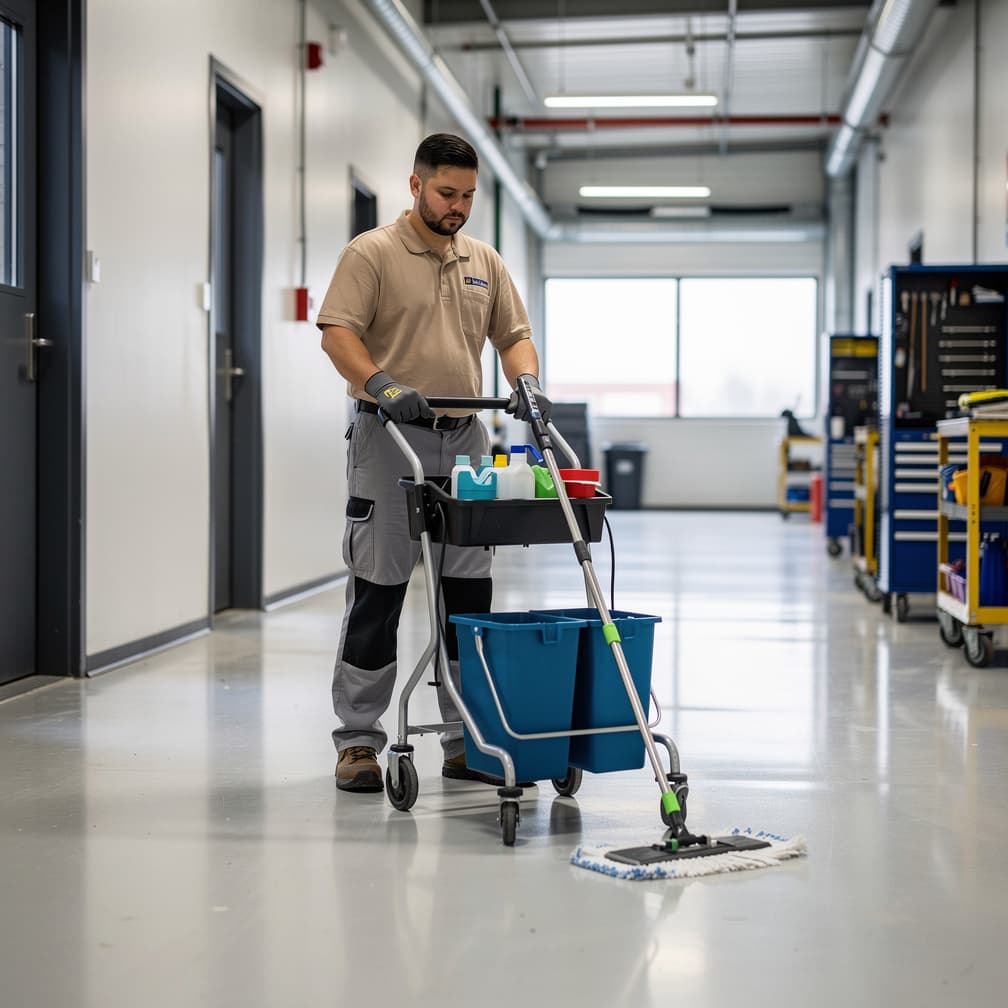

As a janitorial service in Kent, you take on other people's floors, glass, and furniture, and you hand back a signed contract promising to be careful. Janitorial service insurance in Kent is what stands behind that promise when careful is not enough. A cart clips a monitor. A stripped floor cures unevenly and hazes. A visitor goes down near an entrance your crew mopped an hour earlier. Each is a small event with a bill attached, and the bill grows once a lawyer joins the conversation. Liability limits get tested by the argument, not by the damage. Know what your policy would do before a client tells you what they expect it to do. Below, every coverage on this page gets a plain breakdown, with published ranges and the gaps stated honestly.
What Makes Kent Different
Payroll is the meter behind workers compensation, and cleaning is a payroll-heavy trade by nature. Add night shifts, add hours; add hours, add premium, whatever the square footage happens to say. Dense counties push crews toward more buildings per night, and that shows up in the rating basis. One large downtown contract in Kent can double the headcount you report at your next audit. Classification matters too, because floor stripping and high work rate differently from light office cleaning. Describe the actual job mix to a carrier in Washington, since an audit corrects optimism anyway. Claims history is the other lever, and one open injury file can follow you for years. Fix the safety story first; the price argument gets much easier once the losses stop.
Local Risk Factors in Kent
Wildfire smoke closes offices and fills the ones that stay open with ash settling on every surface you are contracted to clean. The scope doubles while the price stays where the contract left it, and your crew breathes whatever the building's air handling missed. Respiratory incidents during that work are employee injuries, and Workers Compensation is generally where they land rather than on any liability form. Payroll during a smoke week is still payroll, and an audit finds it whether or not you reported it. Talk to a participating carrier in Washington about how the work is classified before a Kent fire season makes the question urgent.
What Coverage Does a Janitorial Service in Kent Need?
General Liability
Landlords, property managers, and facility directors ask for this one by name before your crew gets access to a building. It is aimed at bodily injury and property damage your cleaning operations cause to other people: a visitor down on a wet floor, a client's glass panel cracked by a cart. Damage to the surface you were working on, and theft by an employee, typically sit outside it.
Example: A cleaner mops a lobby, a delivery driver walks through before the floor dries, and a wrecked knee becomes a demand letter; general liability may respond to the claim and the defense.
Commercial Property
Flood typically sits outside the standard form, which matters when your machines live at floor level. What the form does address is the fleet and supply side of the business: buffers, extractors, vacuums, ladders, and stock at the address you declare. Equipment kept in client closets or a vehicle usually falls under a much smaller limit, so ask where that line sits before you buy.
Example: A break-in at your storage unit clears out two scrubbers and a pallet of supplies overnight; commercial property can help cover replacement, though the values you declared decide the size of the check.
Workers Compensation
A cleaner slips off a step stool while changing a light diffuser and cannot work for weeks. This is the line built for that: medical costs and lost wages for your own employees, quoted against payroll rather than as a flat monthly figure. Requirements vary by state, and client contracts frequently ask for proof of it whatever the state rules happen to say.
Example: Two crew members walk a ride-on scrubber down a loading dock ramp and one wrenches a shoulder badly; workers compensation is generally where the medical bills and the lost time end up.
Business Owners Policy
Where general liability and commercial property are two contracts, this is one: a package built for smaller cleaning operations, with a single bill and a single certificate. Property caps and eligibility rules are the trade-off, and the aggregate limit is shared across everything inside. Read what the package does with equipment away from your premises before assuming it matches a standalone form.
Example: A fire in the supply room wrecks machines and injures a tenant in the Kent unit next door; a business owners policy can help with both halves, subject to the limits inside the package.
How Much Does Janitorial Service Insurance Cost in Kent?
Janitorial Service Insurance is a bundle of separate policies, priced separately. The ranges below are typical figures for Kent for each line, except workers compensation, which is set by the state fund; a quote prices each one against your own operations.
| Coverage | Typical range | What moves your price |
|---|---|---|
| General Liability Insurance | $60 - $170 per month | Industry and risk classification, annual revenue, number of employees |
| Commercial Property Insurance | $55 - $180 per month | Building value and construction type, roof age and condition, fire protection class |
| Workers Compensation Insurance | Set by the state fund | Employee classification codes, total annual payroll, experience modification rate |
| Business Owners Policy Insurance | $85 - $240 per month | Annual revenue and industry class, building and contents values, square footage and building age |
Prices shown are general estimates, not guaranteed rates or quotes. Your actual premium will depend on the insurer, coverage selected, business details, location, claims history, and other underwriting factors. Learn about our pricing methodology.
What Are the Insurance Requirements for a Janitorial Service in Kent?
Workers' comp is generally required once you have your first employee, through the state fund. Washington runs workers' compensation through a state fund: employers buy coverage from the Washington State Department of Labor & Industries (L&I), not from private carriers. Common exemptions include sole proprietors and partners. Confirm current requirements directly with the fund before you hire.
Flood damage is typically excluded from standard policies. Standard commercial property and builders-risk-type policies typically exclude flood damage. Flood exposure varies address by address, so check your premises in FEMA's Flood Map Service Center before deciding; if you sit in a mapped flood zone, a separate policy through the National Flood Insurance Program is the usual starting point.
Where to verify licensing and coverage rules. The Washington Office of the Insurance Commissioner publishes consumer guidance and current insurance requirements for Washington businesses. When a contract or lease demands specific wording, the Washington Office of the Insurance Commissioner's guidance is the authoritative place to check.
Get Your Janitorial Service Quote in Kent
Compare rates from multiple carriers. Free quotes, no obligation.
Operating in Kent
- Cases of chemicals stacked beside electrical equipment in the storage unit you rent in Kent are a fire conversation. That room is usually the one asset your schedule cannot survive losing.
- King County has about 70,500 businesses, and each one that hires you can ask to be named on your policy, so a growing client list quietly grows the list of parties your limits answer to.
- Loading a ride-on scrubber in and out every night is when it gets dropped or cracked. The expensive damage rarely happens while the machine is actually cleaning anything.
- High dusting and light-fixture work puts a cleaner on a ladder in a room full of glass and monitors. That is how one job produces an injury claim and a property claim together.
How to Buy: Advice for Kent Owners
Certificates of insurance are the operational half of this, and they are where cleaning contracts stall. Ask a carrier how fast they issue one and whether you can request it yourself online. You will need dozens a year, and a two-day turnaround costs you bids you would otherwise win. Confirm the exact legal entity your client wants listed, because the name on the building is often wrong. If a property manager in Kent requires additional insured status, that is an endorsement and not a checkbox. General Liability carries it, and some carriers charge for the wording while others include it. A Business Owners Policy issues certificates through the same workflow, so bundling changes nothing there. Check the Washington Office of the Insurance Commissioner's guidance before deciding what a certificate does and does not prove. Then weigh quotes from participating carriers on issuing speed as well as price.
FAQ
Janitorial Service Insurance in Kent: FAQ
Usually not on the liability side. General liability is built around bodily injury and property damage arising from your operations, and theft by an employee typically sits outside it. Some carriers offer a crime or employee dishonesty endorsement, and the limits there are often small. If a client raises the question during a bid, learn what your policy would really do before you promise anything.
It is an endorsement that extends your liability policy to another party, usually the building owner or the management company. They want it so a claim arising from your cleaning lands on your carrier instead of theirs. A certificate that mentions additional insured without the endorsement attached may not hold up when a claims department reads the file. Ask for the endorsement itself, not the summary.
That is a carrier question, and it is worth asking before you buy rather than after. Some issue certificates the same day through a portal you control; others take days and route the request through a service desk. Cleaning is bid in volume, so slow issuing costs contracts. If a Kent property manager sets a start date within the week, a slow certificate can lose the job outright.
Yes, and they do it routinely. The contract sets the floor, and your policy either meets it or you do not get the work. Reading that clause before you sign is the only way to price the job honestly, since raising a limit partway through a term is slower and sometimes dearer than buying it at renewal. Ask what the step up costs before assuming it is unaffordable.
Possibly, and the location is what decides it. Commercial property coverage often distinguishes equipment at your own premises from equipment away from it, and the away-from-premises limit can be much smaller. Machines that live in a client closet in Kent or in a vehicle overnight are exactly the case to ask about. Declare where your equipment actually sleeps and check the limit that applies there.
Annual payroll, headcount, annual revenue, the building types you clean, the services you perform, your equipment list with values, and your claims history. Carriers rate the work rather than the trade name, so floor stripping, high dusting, and post-construction cleanup each change the picture. Vague answers get conservative pricing. Assemble the file once and every quote afterward describes the same business.
Sources
- 1.U.S. Census Bureau, County Business Patterns (2022), King County(King County has about 70,500 business establishments.)
- 2.Washington Office of the Insurance Commissioner(Washington Office of the Insurance Commissioner publishes consumer guidance for insurance buyers.)
- 3.FEMA / FloodSmart(Flood coverage is typically purchased separately; FEMA administers the National Flood Insurance Program.)


