







































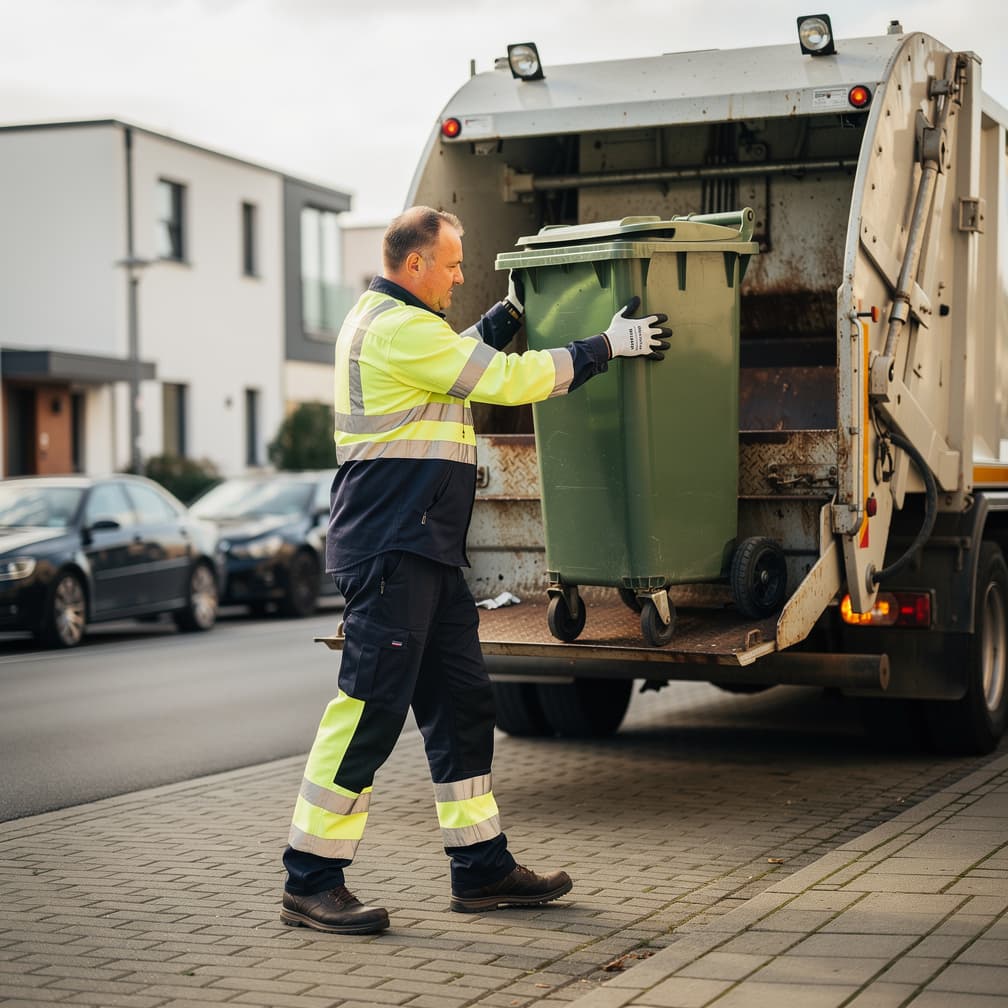

King County has about 70,500 businesses, and every one of them with a container behind the building is a possible account and a possible claimant. Garbage collection service insurance in Seattle has to answer both roles at once, because the loading dock you service is also the pavement your lift arm can crack. Crowded routes mean tight turnarounds, parked cars, and more property sitting within a truck length of your rear wheels. They also mean more contracts, and contracts are where limits and additional insured wording get decided by somebody who is not you. A property manager can hold a start date over a certificate that has not landed yet. The sections below cover what haulers carry, the published price ranges, and the gaps worth asking about before you sign an account you cannot afford to lose.
What Makes Seattle Different
About 61 garbage collection services operate around Seattle, and your truck is not the only heavy vehicle stopping at that gate. When a bollard gets scraped or an apron cracks, the property manager does not always know whose lift arm did it. The complaint lands on whoever was scheduled that morning, and that is often you, deserved or not. Proving otherwise is a camera question, a timestamp question, and a driver statement question, roughly in that order. A claim you did not cause still touches your record while the carrier spends three months sorting it out. That is the quiet cost of running a street that several haulers share every single week. Equip the truck to answer the question before anybody thinks to ask it. Footage is cheaper than an argument you cannot win.
Local Risk Factors in Seattle
Wildfire smoke and closures reach a hauler long before flames would, because a road shut to traffic is a route that does not run. Air quality alone can stop outdoor work, and a crew lifting all shift in heavy smoke is a health question with a claims tail behind it. Worse is what customers throw out during a fire season: hot ash, a barbecue tray, a smoldering yard pile, any of which can ignite inside a loaded packer. Commercial Auto is where a burned truck's own damage would be addressed, and only if the physical damage section is on your quote. Fire loss to your yard and your containers is a property matter outside these lines. Ask what a Seattle quote includes before Washington has a bad fire year.
What Coverage Does a Garbage Collection Service in Seattle Need?
General Liability
Property managers and commercial accounts ask for this line by name, and the certificate they want is proof of it. General Liability can help cover injury to a customer near a collection point, plus damage your crew or your container does to somebody else's property. It typically excludes your own equipment, injuries to your own employees, and anything the truck does on the road.
Example: A resident trips over a bin your crew left across a walkway and breaks a wrist; the medical bills and the demand letter behind them are the kind of claim General Liability may answer.
Commercial Auto
A packer truck backing into a parked car is this trade's most predictable loss, and this is the line built for it. Commercial Auto typically responds to damage and injuries your vehicles cause on a route, and it can extend to a truck's own damage when the physical damage section is purchased. Personal auto policies generally exclude hauling waste for pay.
Example: Your driver clips a gate post and a parked sedan in one reverse at a tight commercial stop in Seattle; repairs to both, and the injury claim that follows, are generally where a Commercial Auto file opens.
Workers Compensation
Lifting is the job, so hands, shoulders, and backs are where this trade's injuries land. Workers Compensation is meant to handle medical care and lost wages for a crew member hurt on the route, whether that is a strain, a cut from a bag of glass, or heat illness. It does not answer for injuries to customers, and requirements vary by state.
Example: A loader tears a rotator cuff dragging an overfilled cart up a slope, and the surgery plus the weeks off the truck are what Workers Compensation is intended to cover.
Commercial Umbrella
Primary limits look enormous until a serious injury involving a heavy truck puts a defense bill and a settlement on the same page. Commercial Umbrella sits above your auto and liability limits and can take over once those are exhausted. It follows the coverage underneath it, so a gap in the primary is usually a gap up here too.
Example: A route collision injures two people and the auto limit is gone before the depositions finish; the layer above is what a Commercial Umbrella might be asked to carry from there.
How Much Does Garbage Collection Service Insurance Cost in Seattle?
Garbage Collection Service Insurance is a bundle of separate policies, priced separately. The ranges below are typical figures for Seattle for each line, except workers compensation, which is set by the state fund; a quote prices each one against your own operations.
| Coverage | Typical range | What moves your price |
|---|---|---|
| General Liability Insurance | $220 - $725 per month | Industry and risk classification, annual revenue, number of employees |
| Commercial Auto Insurance | $1,450 - $4,700 per month | Fleet size and vehicle types, driver records and experience, coverage limits and deductibles |
| Workers Compensation Insurance | Set by the state fund | Employee classification codes, total annual payroll, experience modification rate |
| Commercial Umbrella Insurance | $230 - $1,000 per month | Umbrella limit requested, limits carried on the underlying policies, loss history on those underlying policies |
Prices shown are general estimates, not guaranteed rates or quotes. Your actual premium will depend on the insurer, coverage selected, business details, location, claims history, and other underwriting factors. Learn about our pricing methodology.
What Are the Insurance Requirements for a Garbage Collection Service in Seattle?
Workers' comp is generally required once you have your first employee, through the state fund. Washington runs workers' compensation through a state fund: employers buy coverage from the Washington State Department of Labor & Industries (L&I), not from private carriers. Common exemptions include sole proprietors and partners. Confirm current requirements directly with the fund before you hire.
State auto liability minimums apply to business vehicles. Washington's minimum auto liability limits are $25,000/$50,000/$10,000 (bodily injury per person / per accident / property damage). Contracts and lenders often require more than the state floor.
Where to verify licensing and coverage rules. The Washington Office of the Insurance Commissioner publishes consumer guidance and current insurance requirements for Washington businesses. When a contract or lease demands specific wording, the Washington Office of the Insurance Commissioner's guidance is the authoritative place to check.
Get Your Garbage Collection Service Quote in Seattle
Compare rates from multiple carriers. Free quotes, no obligation.
Operating in Seattle
- Loose paper leaving an open lid at a commercial account in Seattle becomes a cleanup that somebody bills to you, and closing that lid was your crew's job.
- Leachate trailing across a customer's driveway is a slip claim with your name on it, and the person who goes down is rarely an employee you can talk to first.
- Certificates expire on their own schedule and the accounts holding them will not remind you, so diary every expiration date in King County before a gate does it for you.
- A property manager in Seattle can pull your gate code the day a certificate expires, and a route you cannot enter is a route you cannot bill.
How to Buy: Advice for Seattle Owners
Certificates move slower than routes do, so build the request into your onboarding rather than your emergencies. When an account in Seattle sends its insurance exhibit, forward it the same hour to whoever services your policy and ask two questions: does the wording match, and what does the endorsement cost. Additional insured status and a waiver of subrogation are usually the two items in dispute, and neither one is automatic. Those endorsements attach to General Liability for a hauler, and the same account often wants them on Commercial Auto too, which is a separate form with its own number. Keep a folder holding your current certificate, your endorsements, and the holder list, because renewal needs all three. Check the Washington Office of the Insurance Commissioner's guidance before deciding whether a request is standard or unusual. Then compare what participating carriers include by default, since some hand you the endorsement and some sell it back.
FAQ
Garbage Collection Service Insurance in Seattle: FAQ
Pricing follows the trucks and the crew rather than the address. Vehicle weight, radius, driver records, payroll by class, and your claims history do most of the work, and the limits your contracts demand do the rest. A one-truck operation with a clean record and a two-truck operation with a rollover behind it can land far apart. The cost table on this page shows the published ranges by coverage, and a real quote for Seattle comes out of your own numbers.
Commercial accounts, property managers, the landlord behind your yard, and anybody whose contract carries an insurance exhibit. The request usually names limits, asks to be listed as a certificate holder, and often asks for additional insured status on top of that. A residential subscriber rarely asks for anything at all. One commercial account in Seattle can change that in an afternoon, and the paperwork has to exist before the first pickup.
Property damage you cause to somebody else's property is the classic General Liability claim, so a cracked apron under your truck is generally the right address for it. A deductible and a limit both apply, and neither is a formality. It is not the place for the container you damaged yourself, since your own equipment is a separate conversation. Photograph the surface before the first service, because pre-existing cracks have a way of being remembered as yours.
It means your policy answers for that party as well, within the wording of the endorsement, when a claim arises out of your work. A property manager asks for it so your coverage stands in front of their own program after somebody slips near your container. It is not automatic, and it is not the same as being a certificate holder, which only means they receive a copy. Ask for the endorsement by form number and keep the confirmation.
Per occurrence is the most a policy may pay for one event, such as the morning a truck clipped three parked cars on the same street. The aggregate is the ceiling for the whole policy year, and every claim eats into it. A hauler making hundreds of stops a day accumulates small claims quickly, so the aggregate matters more here than it does for a business with one front door. Ask where yours stands at renewal, not after.
Usually not. A delay is a service problem, and policies respond to damage and injury rather than to disappointed customers. Interruption coverage tends to depend on physical damage to property you own, so a breakdown or a shut disposal site rarely triggers anything at all. The remedy for a missed route is a spare truck, a backup driver, and a contract with room in it for bad weather. Read that section before you assume it is broader.
Sources
- 1.U.S. Census Bureau, County Business Patterns (2022), King County(King County has about 70,500 business establishments.)
- 2.U.S. Census Bureau, County Business Patterns (2023), King County(King County has about 61 businesses in this trade's category (NAICS group 562111).)
- 3.Washington Office of the Insurance Commissioner(Washington Office of the Insurance Commissioner publishes consumer guidance for insurance buyers.)


