







































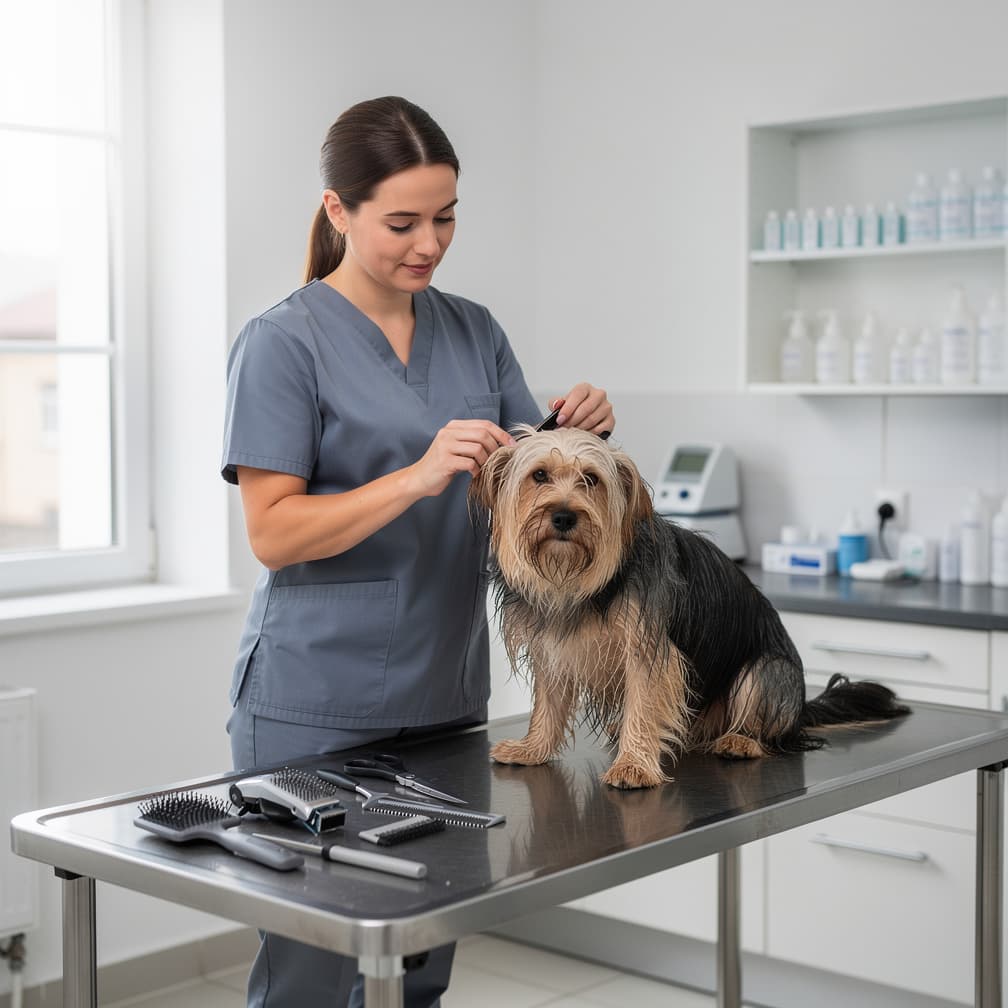

Nobody quotes a grooming shop without asking for payroll first, and that single number moves the total more than square footage does. Pet grooming insurance in Charleston can start from $25 a month for a solo operator with no employees and no storefront, and it stops looking like that the moment you hire or sign a lease. Employees add a wage-based rate. A lease adds a landlord who names limits. A grooming van or a shared suite raises questions about who owns what is inside. None of that is negotiable at quote time, so gather the facts before you shop: headcount, wages, equipment values, and the insurance clause your lease already contains. Then compare West Virginia quotes built on identical inputs.
What Makes Charleston Different
Equipment values drive more of a small shop's premium than owners expect, because the gear list is the property schedule. Tubs, hydraulic tables, high-velocity dryers, clipper sets, and a wall of product add up faster than the room looks. Understating that list saves a little now and pays a fraction later, which is the worst trade in insurance. Overstating it costs you every single month for a loss you are never going to have. A shop in Charleston should inventory the room once a year with a phone camera and a spreadsheet. Deductibles are the other lever, and a high one is only smart if the cash exists to fund it. A thin-margin operation cannot self-insure a loss it has no way to pay inside a single week. Set both numbers against your bank balance in West Virginia, not against a quote comparison.
Local Risk Factors in Charleston
Before the season turns, find out where your shop sits relative to the water and what your form actually says. Coverage for rising water is generally bought apart from a property policy, and the federal flood program is the usual starting point for a small commercial tenant. That decision is not automatic, so nobody makes it on your behalf. Raise what you can: store product off the floor, keep clipper cases on shelves rather than under counters, and photograph the room while it is dry. An inventory made in advance is the difference between a fast claim and an argument in Kanawha County over what a seven-year-old dryer was worth. The building shell is usually the landlord's problem; everything you carried into the Charleston space is yours.
What Coverage Does a Pet Grooming in Charleston Need?
General Liability
Landlords, host clinics, and corporate accounts ask for this one by name. It is the line typically aimed at people rather than pets: the client who slips on a wet floor at pickup, the person bitten in your waiting area, the damage you cause to somebody else's property. Injury to an animal in your care is often excluded and usually needs separate wording, so ask.
Example: A client leans over the desk to sign, slips on water tracked from the tub room, and lands hard; General Liability can help cover the medical bills and the claim that follows.
Professional Liability
Nobody was hurt and the owner is still furious: the coat came off too short, the shave down was never authorized, a sore is blamed on your blade. Those complaints are about the service rather than an injury, and General Liability generally leaves them alone. Professional Liability is the line meant for that argument, and it often funds the defense even when a claim goes nowhere.
Example: An owner books a full groom before a show, returns to a coat clipped shorter than agreed, and demands compensation; Professional Liability might answer the claim and the lawyer's bill.
Commercial Property
Tubs, hydraulic tables, high-velocity dryers, clipper sets, and the product on the shelf are the money in a grooming shop, and they all sit in one room. This line is intended for that room: fire, theft, vandalism, and sudden water from inside the building. Flood is typically excluded and bought separately, and wear on an aging dryer motor is treated as maintenance.
Example: A break-in overnight empties the clipper drawer and takes both dryers from a salon in Charleston; Commercial Property may respond up to the values you scheduled, which is why the inventory matters.
Workers Compensation
A bite to a client and a bite to your bather travel down different roads. This is the employee road: medical care and lost wages when a groomer is hurt lifting a ninety-pound dog, scratched on the table, or injured on a wet floor at work. Rules on who must carry it vary by state and headcount. Rating runs per hundred dollars of payroll rather than as a flat monthly figure.
Example: A bather reaches into a tub, takes a bite that needs stitches, and misses a week of shifts; Workers Compensation is generally intended to handle the medical care and the lost wages.
How Much Does Pet Grooming Insurance Cost in Charleston?
Pet Grooming Insurance is a bundle of separate policies, priced separately. The ranges below are typical figures for Charleston for each line, except workers compensation, which is rated per $100 of payroll; a quote prices each one against your own operations.
| Coverage | Typical range | What moves your price |
|---|---|---|
| General Liability Insurance | $50 - $150 per month | Industry and risk classification, annual revenue, number of employees |
| Professional Liability Insurance | $40 - $140 per month | The services you actually perform, annual revenue or billed fees, limit and retention selected |
| Commercial Property Insurance | $70 - $210 per month | Building value and construction type, roof age and condition, fire protection class |
| Workers Compensation Insurance | $0.75 - $2.74 per $100 of payroll | Employee classification codes, total annual payroll, experience modification rate |
Prices shown are general estimates, not guaranteed rates or quotes. Your actual premium will depend on the insurer, coverage selected, business details, location, claims history, and other underwriting factors. Learn about our pricing methodology.
What Are the Insurance Requirements for a Pet Grooming in Charleston?
Workers' comp is generally required once you have your first employee. West Virginia generally requires employers to carry workers' compensation at that point. Common exemptions include sole proprietors, partners, and some agricultural workers. Confirm current thresholds with your state's workers' compensation agency before you hire.
Flood damage is typically excluded from standard policies. Standard commercial property and builders-risk-type policies typically exclude flood damage. Flood exposure varies address by address, so check your premises in FEMA's Flood Map Service Center before deciding; if you sit in a mapped flood zone, a separate policy through the National Flood Insurance Program is the usual starting point.
Where to verify licensing and coverage rules. The West Virginia Offices of the Insurance Commissioner publishes consumer guidance and current insurance requirements for West Virginia businesses. When a contract or lease demands specific wording, the West Virginia Offices of the Insurance Commissioner's guidance is the authoritative place to check.
Get Your Pet Grooming Quote in Charleston
Compare rates from multiple carriers. Free quotes, no obligation.
Operating in Charleston
- Corporate accounts and host clinics tend to hand down insurance exhibits written for every location in the chain, so a two-table shop in Charleston gets the same limit requirement as a warehouse.
- Shedding season fills the book and lengthens the day, and tired hands at the end of a fourth dog are how a blade catches skin.
- Certificates go stale the moment your policy number changes at renewal, so every landlord, clinic, and account holding an old copy needs a fresh one that same week.
- A claim can arrive three weeks after the appointment, by letter, with a vet invoice attached and a tone that was nowhere in the room at pickup.
How to Buy: Advice for Charleston Owners
Pick the limit before you pick the price. A per-occurrence limit on General Liability is what one incident can draw; the aggregate is all the policy will do in a year, and a busy grooming floor can test both. Defense costs are the part people forget: if they sit inside the limit, every hour a lawyer bills is money not available for the vet bill. Ask each quote where defense sits. On the property side, set the deductible against cash you actually have, since a high one is only a saving until the dryer dies in midwinter. Workers Compensation deductibles work differently and deserve a separate question. The West Virginia Offices of the Insurance Commissioner publishes consumer guidance on policy limits and deductibles. Once you have chosen your numbers, use CPK to compare quotes from participating carriers holding those numbers fixed across West Virginia.
FAQ
Pet Grooming Insurance in Charleston: FAQ
A certificate is a snapshot of your policy on the day it is issued, and it goes stale the moment anything changes. Corporate accounts and host clinics usually want to be listed and often want notice of cancellation. A referral partner in Kanawha County can pause your bookings the day the certificate on file expires, so keep a list of everyone holding a current one.
Most commercial policies respond to incidents that occur while coverage is in force, so a gap is not a discount, it is an uninsured window. A landlord or a referral partner in Charleston can also treat a lapse as a breach and pause your access to the space or the account. Reinstatement can require new underwriting. Set the renewal to pay automatically, then check that it actually did.
Theft of business equipment is usually a property question rather than a liability one, and the answer depends on the values you scheduled and where the gear was when it disappeared. Equipment kept in a locked salon is treated differently from equipment left in a mobile setup overnight. Ask that question specifically before you take a route around Charleston. Under-scheduling your tools saves a little monthly and pays a fraction once.
The build-out, the delivered tubs, and the product on the shelves are at risk before your first client arrives, and so is the contractor's helper walking your floor. Coverage typically responds from its effective date forward, so a policy bought after an incident does nothing for that incident. Line the start date up with possession of the space in Charleston, rather than with opening day.
Personal policies generally exclude business activity, and grooming clients' animals at home is business activity in an insurer's eyes. The client walking up your driveway, the dog in your tub, and the equipment in your garage are all commercial exposures. Assuming otherwise is how a denied claim happens. Ask about a commercial policy written for the work instead of hoping the personal one stretches.
Per occurrence is the most a policy may pay for one incident, such as a single client's fall at your front desk. The aggregate is the ceiling across the whole policy year, no matter how many incidents there were. A grooming floor with dogs and owners moving through it all day has more chances to reach that second number than a quiet office does. Leases usually name both figures, so read them separately.
Sources
- 1.West Virginia Offices of the Insurance Commissioner(West Virginia Offices of the Insurance Commissioner publishes consumer guidance for insurance buyers.)
- 2.FEMA / FloodSmart(Flood coverage is typically purchased separately; FEMA administers the National Flood Insurance Program.)


