







































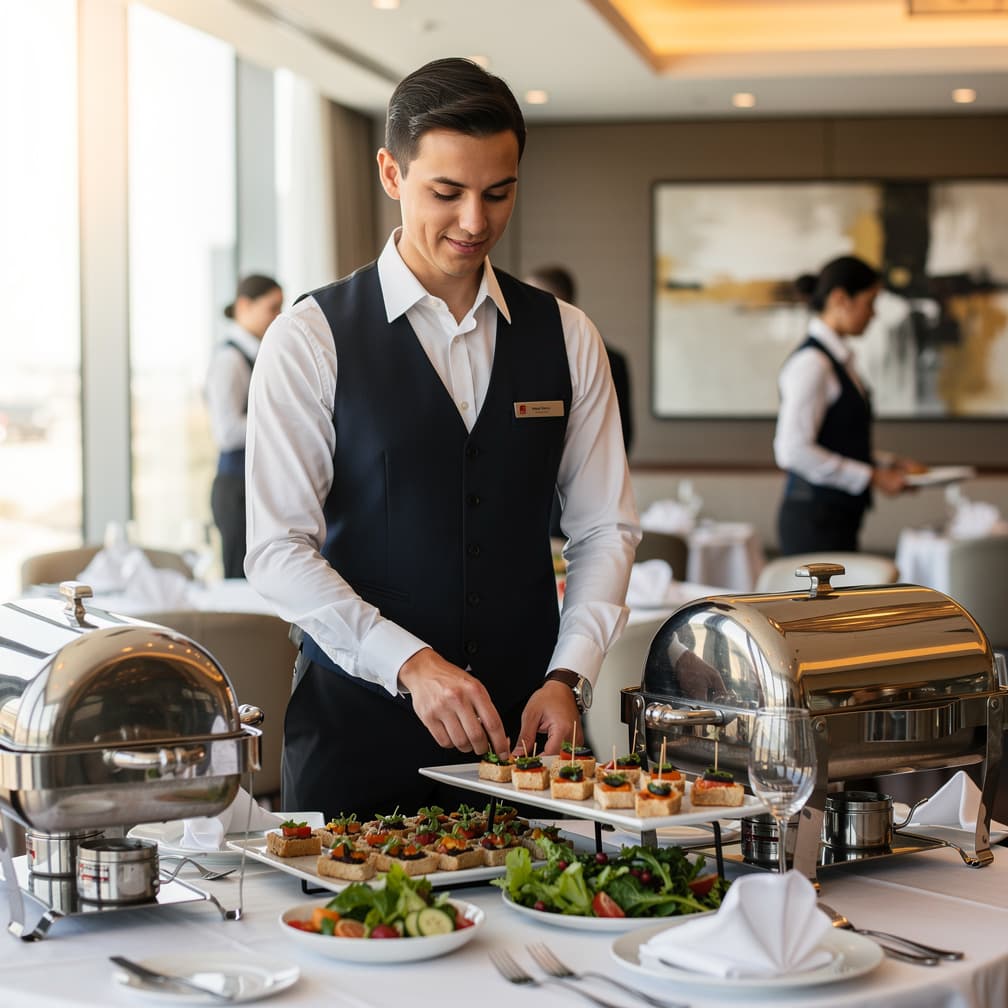

As a catering business in Huntington, you spend most of your working hours inside buildings you do not control, and that single fact drives what catering business insurance in Huntington has to do. The venue's floor, the client's carpet, the rented banquet hall's walls: your equipment moves through all of them on a deadline. Damage during setup or teardown is a claim against you, and a venue in Huntington can invoice for the repair rather than forgive it. Guests are the other half. They move around hot pans and wet floors while nobody in the room is thinking about liability. Then there is the drive, with staff, food, and a van full of gear that costs more than the truck. The sections ahead lay out the coverages caterers weigh and what a quote requires, so you can compare options against the way your jobs actually run.
What Makes Huntington Different
Contracts get shorter in a small market and the requirements inside them get vaguer, which is its own problem. A one-page agreement that says fully insured tells you nothing about limits, wording, or who gets named. Ask what the client actually needs before you promise it, because a promise in a signed contract binds you. If a job crosses into Cabell County or past it, ask whether the venue there wants different paperwork. Certificates cost nothing to reissue, and forgetting one costs you the job at the loading dock. Keep the additional insured question on your booking checklist next to headcount and dietary notes. The paperwork then gets solved at the deposit stage instead of at the service entrance. A client in Huntington who never asks is not the same as a client who never will.
Local Risk Factors in Huntington
A week of canceled events does the same damage to a catering business as a foot of water in the kitchen, and a flood delivers both at once. Guests do not travel, venues shut, and the deposits already spent on protein and rentals do not come back. Your van is the other exposure, since a flooded street is where a delivery becomes a total loss with the whole event in the back. Commercial Auto may respond to flood damage to a vehicle only where comprehensive coverage sits on that unit, which is worth confirming rather than assuming. Ask what happens to the food in the back too, because the cargo and the truck are answered differently. Flood risk changes street by street across Cabell County and West Virginia, so put the question on your renewal checklist in Huntington.
What Coverage Does a Catering Business in Huntington Need?
General Liability
A guest trips near the buffet line and files a claim, and that is the exposure this line exists for. Venues and corporate clients name it in their contracts, and it commonly answers third-party bodily injury or property damage arising out of your work. It generally excludes injuries to your own staff and damage to property in your care.
Example: A server sets a chafing dish on a folding table that gives way, and a guest reaching past it is burned; the injury claim that follows is what general liability may answer.
Commercial Auto
Anyone financing your van wants proof of this, and an event contract usually assumes it exists the moment you deliver. Rating turns on the vehicles, the drivers, and the miles, and the line can help cover liability and damage after a crash on the way to a job. A personal auto policy typically steps aside once the trip is business.
Example: Your van gets rear-ended crossing town with two hundred covered plates in the back; the truck repair sits with Commercial Auto, while the ruined food is usually a separate conversation.
Commercial Property
Flood sits outside this form, and so does wear and tear, which is where an honest reading of it starts. What it typically handles is your own equipment and stock: warmers, cold storage, racks, china, and linens, when a named peril damages them. Theft and vandalism are commonly included, subject to the deductible you choose.
Example: Somebody pries open the van overnight in Huntington and the warmers and cambros are gone by morning; commercial property might help cover the replacements once your deductible is met.
Liquor Liability
General Liability commonly excludes claims tied to serving alcohol, and this line exists to fill that hole. It is meant for the wedding or corporate event where your own staff pours, and it may respond when an overserved guest causes harm to someone. Venues often require it in writing before a bar opens in their room, and the terms vary by carrier.
Example: A guest keeps drinking well past the point your bartender should have stopped, then injures somebody on the way home; liquor liability is the line that gets tested.
Workers Compensation
Burns, knife cuts, and slips on a wet prep floor are the routine injuries in a catering kitchen, and this is the line built for them. Pricing runs per $100 of payroll and gets audited afterward, and the coverage may help cover medical costs and lost wages for staff hurt on the clock. Whether it is required depends on where you operate and how many people you employ.
Example: A server carrying a tray goes down in a wet service aisle in Huntington and misses three weeks; workers' compensation is generally where that medical bill and those lost wages land.
How Much Does Catering Business Insurance Cost in Huntington?
Catering Business Insurance is a bundle of separate policies, priced separately. The ranges below are typical figures for Huntington for each line, except workers compensation, which is rated per $100 of payroll; a quote prices each one against your own operations.
| Coverage | Typical range | What moves your price |
|---|---|---|
| General Liability Insurance | $80 - $240 per month | Industry and risk classification, annual revenue, number of employees |
| Commercial Auto Insurance | $180 - $500 per month | Fleet size and vehicle types, driver records and experience, coverage limits and deductibles |
| Commercial Property Insurance | $75 - $290 per month | Building value and construction type, roof age and condition, fire protection class |
| Liquor Liability Insurance | $35 - $150 per month | Share of sales that comes from alcohol, type of venue and how late you serve, server training and service procedures |
| Workers Compensation Insurance | $0.75 - $2.74 per $100 of payroll | Employee classification codes, total annual payroll, experience modification rate |
Prices shown are general estimates, not guaranteed rates or quotes. Your actual premium will depend on the insurer, coverage selected, business details, location, claims history, and other underwriting factors. Learn about our pricing methodology.
What Are the Insurance Requirements for a Catering Business in Huntington?
Workers' comp is generally required once you have your first employee. West Virginia generally requires employers to carry workers' compensation at that point. Common exemptions include sole proprietors, partners, and some agricultural workers. Confirm current thresholds with your state's workers' compensation agency before you hire.
State auto liability minimums apply to business vehicles. West Virginia's minimum auto liability limits are $25,000/$50,000/$25,000 (bodily injury per person / per accident / property damage). Contracts and lenders often require more than the state floor.
Flood damage is typically excluded from standard policies. Standard commercial property and builders-risk-type policies typically exclude flood damage. Flood exposure varies address by address, so check your premises in FEMA's Flood Map Service Center before deciding; if you sit in a mapped flood zone, a separate policy through the National Flood Insurance Program is the usual starting point.
Where to verify licensing and coverage rules. The West Virginia Offices of the Insurance Commissioner publishes consumer guidance and current insurance requirements for West Virginia businesses. When a contract or lease demands specific wording, the West Virginia Offices of the Insurance Commissioner's guidance is the authoritative place to check.
Get Your Catering Business Quote in Huntington
Compare rates from multiple carriers. Free quotes, no obligation.
Operating in Huntington
- Alcohol service turns a booking into a different kind of risk, and a client in Huntington can ask for written proof of liquor coverage before letting a bar open in the room.
- Deposits go out before revenue comes in. Proteins, rentals, and staff are committed days ahead, so a cancellation leaves you carrying costs the client never sees on an invoice.
- Teardown happens late, in the dark, with tired people rolling carts across floors somebody else paid to refinish. That is when a venue in Huntington starts writing down the damage.
- A walk-in that fails takes two weekends with it, since the prep inside becomes unusable and the replacement stock has to be bought again at whatever the market charges that day.
How to Buy: Advice for Huntington Owners
Start with the kitchen lease and the two biggest event contracts you signed around Huntington, because they already decided part of this for you. Note the limits each one demands, whether they want additional insured status, and how much notice they require before cancellation. That gives you the floor for General Liability, and it usually explains why a bargain quote will not clear the room. Add the vans next: Commercial Auto is rated on the vehicles, the drivers, and the miles, so have the plate numbers and driving records ready. If you pour alcohol at events, say so out loud at the quote stage rather than letting an underwriter find out after a loss. The West Virginia Offices of the Insurance Commissioner publishes consumer guidance on how commercial policies are cancelled and renewed. Then compare quotes from participating carriers with the same limits typed into each submission, so the price differences you see are real ones.
FAQ
Catering Business Insurance in Huntington: FAQ
Usually not. Once a vehicle carries food, staff, or event gear for the business, a personal auto policy typically steps aside and the loss becomes a commercial question. Commercial Auto is rated on the vehicles, the drivers, and the miles you run around Huntington, and it is what most contracts expect to see listed. If a server ever runs an errand in their own car mid-event, ask about hired and non-owned wording too.
It depends on where the policy says your property sits. Gear that lives at a fixed address is treated differently than gear spending weekends in a parking lot, and Commercial Property forms vary on exactly that point. Theft and vandalism are commonly named perils, subject to your deductible, though only if the schedule lists the equipment in the first place. Photograph the gear, value it honestly, and ask whether coverage follows it off-site.
Yes, and it happens constantly with corporate accounts and public venues. The contract sets a floor, and a client in Huntington can hold the booking until you clear it. Raising a limit is usually less expensive than owners expect, and doing it mid-season is the awkward part rather than the costly one. Read the limits clause before you sign instead of the week of the event, then keep your strictest contract as the benchmark.
Per occurrence is the most a policy may pay for a single claim, and the aggregate is the ceiling for the whole policy year. A caterer working events every weekend has far more chances to test that aggregate than a business doing four galas a year. Two claims in a busy stretch can leave less room than you assumed for a third. Ask what your aggregate is and how quickly your calendar could reach it.
Sometimes, and the detail lives in the form. Spoilage after a power failure may be included, excluded, or added by endorsement, and equipment breakdown is often a separate conversation from storm damage. Commercial Property is the line to ask about, along with what your deductible does to a claim that size. Ask before the season, because owners tend to ask this for the first time while the walk-in is warming.
You do, at least at first, since the venue invoices whoever caused the damage. Whether your policy responds depends on the wording: liability forms commonly limit or exclude damage to property in your care, custody, or control, which is exactly what a room you are working in becomes. Ask the question in those words before a venue in Huntington sends the invoice. General Liability is the line involved, and the answer varies more between carriers than the price does.
Sources
- 1.West Virginia Offices of the Insurance Commissioner(West Virginia Offices of the Insurance Commissioner publishes consumer guidance for insurance buyers.)
- 2.FEMA / FloodSmart(Flood coverage is typically purchased separately; FEMA administers the National Flood Insurance Program.)


