







































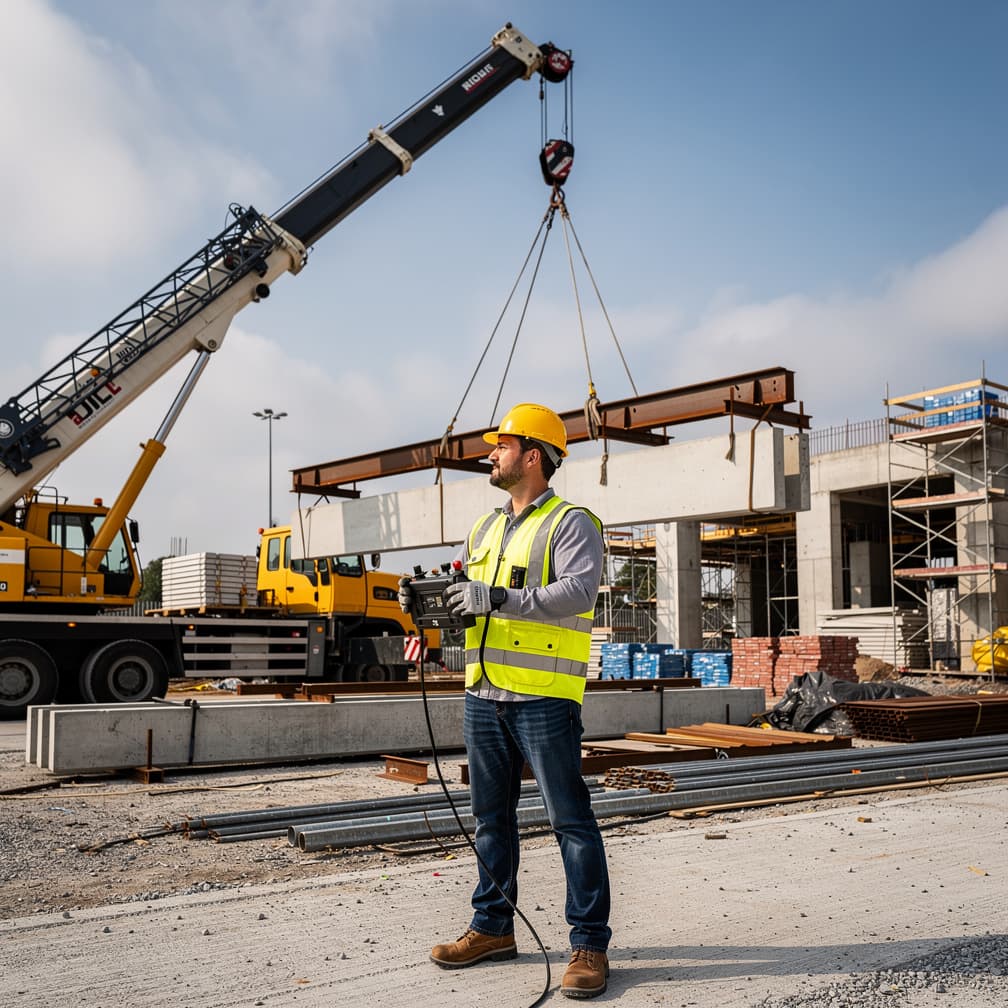

With about 1,100 business establishments in Albany County, the odds that your next lift happens beside somebody else's occupied building are not small. That single fact reorders what matters in crane operator insurance in Laramie: third-party property damage stops being an abstraction and becomes the exposure your limit is chosen against. A boom does not know where the property line runs. Owners and general contractors know it well, which is why the additional-insured wording on your certificate gets read more carefully than your rate. Somebody in that chain asks you for proof before the outriggers go down. Read on for which coverages the contracts name, what carriers want in a submission, and which losses a standard form leaves sitting with you.
What Makes Laramie Different
Owners headquartered far away write the same insurance schedule for a one-day rural lift as for a tower job. That schedule can demand limits which look absurd beside the invoice you are quoting in Laramie. You meet them or lose the work, which is why an umbrella conversation starts at the contract, not at renewal. Rural does not mean lenient, because the requirement was drafted by a risk manager who will never visit. Read the exhibit attached to the contract; insurance terms are rarely written into the body itself. Certificates get rejected for small things: a missing form number, a stale date, a wrong entity name. Fixing one late costs a mobilization, and out here mobilization is measured in hours of driving across Wyoming. Ask participating carriers what a required limit actually costs before you decide it is impossible.
Local Risk Factors in Laramie
Severe storms arrive fast enough that a lift plan built at sunrise is worthless by mid-afternoon. A boom in the air during a squall line is the scenario every operator trains to avoid and every schedule quietly pressures. Damage to your own machine from wind or debris is generally a property or equipment question, subject to the form's terms. The harder claim is what a storm does to somebody else's property while your crane stands on their site. General Liability might answer a third-party claim, depending on the facts and the exclusions, though nobody wants to test it. Storm cells in Wyoming do not respect a bid schedule, and a Laramie job shut down mid-lift costs money no policy returns. Build the shutdown decision into the contract rather than into the moment.
What Coverage Does a Crane Operator in Laramie Need?
General Liability
Owners and general contractors ask for this one by name before a crane reaches their gate. It is the line that typically answers third-party bodily injury and property damage arising out of your lift work: the neighbour's wall, the parked car, the visitor caught by a swinging tag line. Property in your care, custody, or control is commonly excluded, so the client's load on your hook is a separate conversation entirely.
Example: A boom swings wide on a tight setup and clips the cornice of the building next door. The owner's repair estimate and their lost trading day both land on you, and this line may be what meets them.
Workers Compensation
A rigger's hand goes between a shackle and a load, and the medical bill starts before the shift ends. This coverage is built around work injuries to your own crew: treatment, wage replacement, and the proof your general contractor demands to see. It is rated per hundred dollars of payroll by class, so an operator and an oiler price differently. Injuries to anyone off your payroll sit outside it.
Example: An oiler slips on an icy deck plate while rigging a lift and breaks a wrist. Time off and treatment follow, and a claim like that typically runs through this line rather than against your liability limit.
Tools & Equipment (Inland Marine)
Wear on a sling and a thief emptying your rigging trailer are not the same loss, and only one is in scope here. This line follows gear that moves: slings, shackles, spreader bars, trailers, and often the crane itself, depending how it is scheduled. The schedule is the claim, since equipment listed at a stale value settles at a stale number. Wear, tear, and mechanical breakdown are commonly excluded.
Example: Someone cuts the lock on a rigging trailer overnight and empties it of chains and spreader bars. A form written on an agreed-value basis could settle that very differently from one written at actual cash value.
Commercial Auto
The crane is the machine everyone insures and the support truck is the one that crashes. This line sits on the vehicles instead: boom trucks, pickups, and the tractor hauling your rigging trailer, along with the drivers and the miles behind them. Personal auto forms commonly exclude business use, so a crew member's own vehicle on a job raises a hired and non-owned question worth asking early.
Example: A pickup hauling counterweights rear-ends a car on the way to a Laramie job. The other driver's injury claim and vehicle damage would generally fall to this line, not to your liability policy.
Commercial Umbrella
Limits are what a serious lift claim tests, and a primary policy has a ceiling. This coverage sits above the underlying lines and can raise the number your certificate shows, which is often the only way to meet what a large contract demands. It follows those underlying policies, so a gap below tends to become a gap above. It does not broaden what they answer for.
Example: One dropped load draws claims from the owner, the neighbour, and an injured worker's employer, and the primary limit runs dry partway through. What sits above it might pick up from there, subject to its own terms.
How Much Does Crane Operator Insurance Cost in Laramie?
Crane Operator Insurance is a bundle of separate policies, priced separately. The ranges below are typical figures for Laramie for each line, except workers compensation, which is set by the state fund; a quote prices each one against your own operations.
| Coverage | Typical range | What moves your price |
|---|---|---|
| General Liability Insurance | $500 - $2,000 per month | Industry and risk classification, annual revenue, number of employees |
| Workers Compensation Insurance | Set by the state fund | Employee classification codes, total annual payroll, experience modification rate |
| Inland Marine Insurance | $350 - $1,550 per month | Total insured value of the scheduled property, type and age of the equipment, where it is stored and how far it travels |
| Commercial Auto Insurance | $440 - $1,475 per month | Fleet size and vehicle types, driver records and experience, coverage limits and deductibles |
| Commercial Umbrella Insurance | $310 - $1,325 per month | Umbrella limit requested, limits carried on the underlying policies, loss history on those underlying policies |
Prices shown are general estimates, not guaranteed rates or quotes. Your actual premium will depend on the insurer, coverage selected, business details, location, claims history, and other underwriting factors. Learn about our pricing methodology.
What Are the Insurance Requirements for a Crane Operator in Laramie?
Workers' comp is generally required once you have your first employee, through the state fund. Wyoming runs workers' compensation through a state fund: employers buy coverage from the Wyoming Department of Workforce Services, not from private carriers. Common exemptions include sole proprietors and partners. Confirm current requirements directly with the fund before you hire.
State auto liability minimums apply to business vehicles. Wyoming's minimum auto liability limits are $25,000/$50,000/$20,000 (bodily injury per person / per accident / property damage). Contracts and lenders often require more than the state floor.
Where to verify licensing and coverage rules. The Wyoming Department of Insurance publishes consumer guidance and current insurance requirements for Wyoming businesses. When a contract or lease demands specific wording, the Wyoming Department of Insurance's guidance is the authoritative place to check.
Get Your Crane Operator Quote in Laramie
Compare rates from multiple carriers. Free quotes, no obligation.
Operating in Laramie
- Slings, shackles, and spreader bars ride in an open trailer between jobs, and thieves know exactly what that steel is worth. Whatever is missing from the equipment schedule is missing from the claim.
- Working near overhead lines in Albany County means coordinating a clearance or a shutdown with the utility, and the timing of that one call decides whether a lift happens at all.
- Most lift claims start with a sentence nobody heard clearly. A signal person on a blind lift is the entire safety system, and an underwriter will ask how yours was trained.
- The weight of a crane on a client's parking deck or pavement is its own exposure, and an owner in Laramie can bill you for cracked concrete long after the load is set.
How to Buy: Advice for Laramie Owners
Gather four things and most of the work is done: payroll by class, equipment values, loss runs, and your contracts. Payroll drives Workers' Compensation, equipment values drive Inland Marine, and the contracts decide which General Liability limit you actually need. Loss runs decide whether anyone believes you, and they take time to obtain, so request them first. An underwriter reading a complete file prices what is in front of them rather than what they imagine. Incomplete files come back conservative, and conservative means expensive. The Wyoming Department of Insurance publishes consumer guidance on what a commercial submission includes. Send that file through CPK and participating carriers can quote a Laramie crane operator on the same facts, which is the only fair comparison there is.
FAQ
Crane Operator Insurance in Laramie: FAQ
Usually, through an endorsement your carrier has to issue, and not every carrier issues every version of it. The wording matters: primary and non-contributory language and a waiver of subrogation are separate requests with separate answers. If a contract in Laramie demands a combination your policy cannot deliver, you want to learn that at quote time rather than at award. Ask before you sign anything.
Per-occurrence is the most a policy may pay for one event; the aggregate is the ceiling across the whole term. One dropped load stays a single occurrence even when four parties send bills, and all four get paid out of that occurrence limit. A busy year of small claims can eat the aggregate without any single loss looking serious. Check both numbers against your contracts.
Inland Marine is generally the line written for tools and equipment that move between sites, and theft is commonly within it. Two details decide the claim: whether the slings, shackles, and spreader bars are actually on the schedule, and how the form values them. A stale schedule pays a stale number. Photograph what rides in the trailer and update values before renewal, not after a loss.
A vehicle used for the business generally needs a commercial policy, and a personal auto form commonly excludes business use. Your support truck, the rigging trailer, and any boom truck belong in that conversation. Hired and non-owned exposure appears the moment a crew member uses their own vehicle for a Laramie job. Ask each carrier what is included by default and what has to be added.
Payroll by class, revenue, a list of cranes with values, a driver list, and three years of loss runs. Contracts help too, since they show the limits you are already obliged to carry. Missing information does not delay a quote so much as inflate it, because carriers price uncertainty upward. Assemble the file once, put it to several participating carriers, and a Laramie operator gets numbers built on identical facts.
Generally not. Standard commercial forms respond to physical damage and to liability, and an idle day is neither of those. Some contracts carry standby language that pays for a crane and crew held on site, which is a contract question rather than an insurance one. Read that clause before the season fills. The exception worth watching is damage caused by lifting anyway, which nobody enjoys explaining.
Sources
- 1.U.S. Census Bureau, County Business Patterns (2022), Albany County(Albany County has about 1,100 business establishments.)
- 2.Wyoming Department of Insurance(Wyoming Department of Insurance publishes consumer guidance for insurance buyers.)


