







































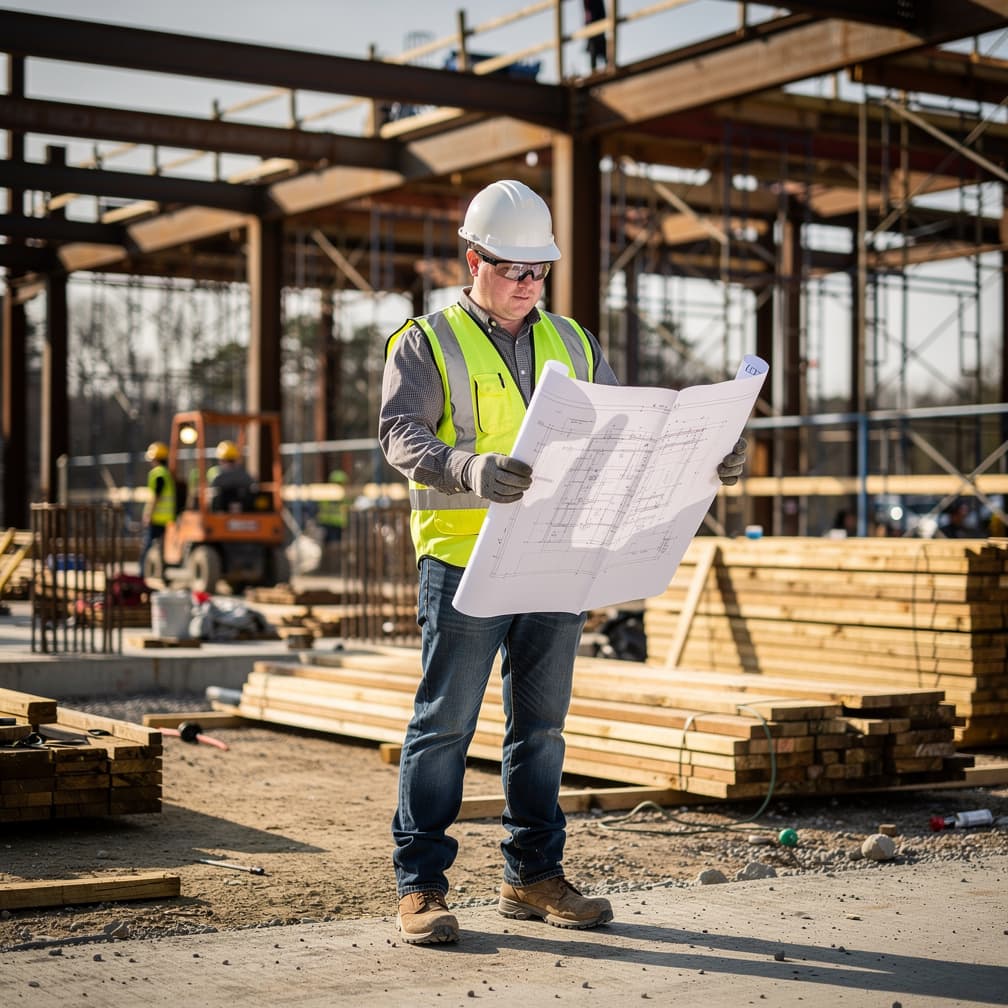

A subcontractor's mistake rarely stays with the subcontractor. The owner reads the contract, finds your name on it, and sends the demand letter to you. General contractor insurance in Buffalo exists for that routing problem: framing that fails inspection, a roof left open before a storm week, a laborer hurt on an active floor. Certificates get demanded before the first permit is pulled, and the limits printed on them have to match what the contract already promised. Erie County has about 22,500 businesses, and any owner among them can set the paperwork bar before your crew mobilizes. Read the cards below for what each line is meant to do, then price it against the jobs you are actually bidding.
What Makes Buffalo Different
Weather stops work everywhere, and what changes is how much a stopped week costs. On a dense Buffalo site with a crane, a street permit, and forty people scheduled, a rain delay is not free. Remobilization has a price, and the contract rarely lets you send that bill to anybody else. The insurance question underneath it is narrower: what happens to material and to work already standing in place. Uncovered lumber, an open deck, and stacked drywall are money you spent that nobody has paid you for yet. Owners and lenders usually dictate who buys coverage for the structure while it goes up, so read that clause early. If it is yours to buy, the limit needs to track completed value rather than today's percentage. Ask that question in Buffalo at contract time, because after the storm it is an argument instead of a decision.
Local Risk Factors in Buffalo
Standing water on an unfinished slab is a schedule problem before it is a claim: crews stand down, inspections slip, and the material you already bought sits in it. Damage of that kind is not what a builders risk form is generally built to answer, since flood is written and rated separately almost everywhere. Where a project sits in a mapped Buffalo flood zone, a lender usually decides the question for you and names the coverage it wants before closing. Read that requirement early, because the wait between buying flood coverage and its effective date can be measured in days you do not have. Storing material high and staging deliveries closer to install can do more for the exposure than any endorsement available in Erie County.
What Coverage Does a General Contractor in Buffalo Need?
General Liability
Owners, lenders, and permit offices ask for this one by name, and the insurance exhibit in your contract usually dictates its limit. It is meant for third-party harm arising out of your work: a passerby struck by falling material, a neighbor's wall cracked by your excavation, and the lawsuit that follows either. Redoing your own defective workmanship typically sits outside it.
Example: A pallet of siding tips off a forklift and takes out a parked car and the driver's shoulder with it; the claim and the defense costs are what General Liability is meant to absorb.
Workers Compensation
Payroll is the meter here: premium is rated per unit of payroll by class code, so what your crew actually does all day matters more than how many of them there are. It generally responds to on-the-job injury, reaching medical care and a share of lost wages, and it commonly bars the employee from suing you over the same injury. Subs without their own coverage can land on your payroll at audit.
Example: A framer misses a step on a stair tower and tears a rotator cuff before the coffee is cold; Workers Compensation can pick up the medical bills and part of the wages he loses.
Builders Risk
A finished-property form has nothing to attach to while a building is still going up, and that is the space this line fills. It typically reaches the structure in progress, materials stored on site, and often materials in transit, up to the completed value written into the policy. Contracts decide whether the owner buys it or you do. It generally ends once the job is complete and accepted.
Example: Wind peels the temporary wrap off a half-framed house in Buffalo and a night of rain ruins insulation already installed; Builders Risk is the line intended to answer for that in-progress loss.
Commercial Auto
Trucks hauling crews, tools, and material are doing business driving, and personal auto policies commonly exclude exactly that. This line rates on the vehicles, the radius they run, and the driving records of whoever holds the keys. It might respond to injury and damage you cause to others, and to the truck itself where you bought that piece. Contracts can require an owner be named on it too.
Example: A crew truck rear-ends a sedan at a light on the way to a morning pour in Buffalo; the other driver's injury claim falls to Commercial Auto rather than to anything on the job site.
Tools & Equipment (Inland Marine)
Property coverage tends to stop at a building, and your compressor, laser level, and generator never stay inside one. This line follows the gear between the yard, the truck, and the site, usually working off a schedule you build with replacement values on it. Theft from a locked box, damage in transit, and equipment knocked off a tailgate are the everyday claims. Wear and tear typically sits outside it.
Example: Somebody cuts the lock on a site box overnight and the impact wrenches, the laser, and the plate compactor are gone by sunrise; Inland Marine could fund the replacements on your schedule.
Commercial Umbrella
When an owner demands a limit larger than a primary policy will sell you, this is usually how contractors reach the number. It sits above the liability and auto policies underneath it and may extend those limits once the underlying ones are used up. It follows the terms beneath it, so a gap downstairs is generally a gap upstairs as well.
Example: A scaffold collapse hurts three people in one afternoon and the primary limit is gone before the second claim settles; Commercial Umbrella might carry whatever is left of the exposure.
How Much Does General Contractor Insurance Cost in Buffalo?
General Contractor Insurance is a bundle of separate policies, priced separately. The ranges below are typical figures for Buffalo for each line, except workers compensation, which is rated per $100 of payroll; a quote prices each one against your own operations.
| Coverage | Typical range | What moves your price |
|---|---|---|
| General Liability Insurance | $230 - $875 per month | Industry and risk classification, annual revenue, number of employees |
| Workers Compensation Insurance | $0.75 - $2.74 per $100 of payroll | Employee classification codes, total annual payroll, experience modification rate |
| Builders Risk Insurance | $80 - $410 per month | Quoted individually based on your operations and limits |
| Commercial Auto Insurance | $230 - $850 per month | Fleet size and vehicle types, driver records and experience, coverage limits and deductibles |
| Commercial Umbrella Insurance | $100 - $410 per month | Umbrella limit requested, limits carried on the underlying policies, loss history on those underlying policies |
Prices shown are general estimates, not guaranteed rates or quotes. Your actual premium will depend on the insurer, coverage selected, business details, location, claims history, and other underwriting factors. Learn about our pricing methodology.
What Are the Insurance Requirements for a General Contractor in Buffalo?
Workers' comp is generally required once you have your first employee. New York generally requires employers to carry workers' compensation at that point. Common exemptions include sole proprietors of one-person businesses and some ministers and clergy. Confirm current thresholds with your state's workers' compensation agency before you hire.
State auto liability minimums apply to business vehicles. New York's minimum auto liability limits are $25,000/$50,000/$10,000 (bodily injury per person / per accident / property damage). Contracts and lenders often require more than the state floor.
Flood damage is typically excluded from standard policies. Standard commercial property and builders-risk-type policies typically exclude flood damage. Flood exposure varies address by address, so check your premises in FEMA's Flood Map Service Center before deciding; if you sit in a mapped flood zone, a separate policy through the National Flood Insurance Program is the usual starting point.
Where to verify licensing and coverage rules. The New York State Department of Financial Services publishes consumer guidance and current insurance requirements for New York businesses. When a contract or lease demands specific wording, the New York State Department of Financial Services's guidance is the authoritative place to check.
Get Your General Contractor Quote in Buffalo
Compare rates from multiple carriers. Free quotes, no obligation.
Operating in Buffalo
- A job an hour outside Buffalo costs fuel and wages before a tool moves, and that same distance stretches how long a replacement machine takes to arrive after a theft.
- Deliveries land on the supplier's schedule rather than yours, so lumber often sits on an open Buffalo site for days before anyone can install a stick of it.
- The permit office, the lender, and the owner can each demand different proof of coverage for the same job, and none of them coordinate with the others.
- Copper, catalytic converters, and unattended compressors leave job sites at night, and a second theft often follows once a site is known to be worth visiting.
How to Buy: Advice for Buffalo Owners
Time the shopping, since a renewal handled in the final week is a renewal you lose. Start sixty days out, when payroll for the year is known and last year's audit has already landed. That is also the window to fix class codes, because a correction made at renewal costs less than a correction made at audit. Check whether the limits on your General Liability still clear the highest bar any current Buffalo contract sets, and whether your equipment schedule matches what is in the trucks. Add Inland Marine items you bought during the year instead of discovering the gap after a theft. The New York State Department of Financial Services publishes consumer guidance on shopping commercial coverage. Give participating carriers a complete, current picture with time to respond, and the comparison you get back is worth acting on.
FAQ
General Contractor Insurance in Buffalo: FAQ
Ask them to name the exclusions that matter for construction rather than reciting what is included. Ask whether the aggregate resets per project or per policy year. Ask how additional-insured endorsements get issued and what wording they will agree to. Ask what happens at audit when a sub turns out to be uninsured. Those answers separate quotes that look identical on price, and comparing participating carriers on terms is worth more than shaving a few dollars.
Payroll, gross receipts, and the split between work you self-perform and work you sublet do most of the pricing. Underwriters also weigh claims history, the limits your contracts demand, and what your crews physically do all day. A framing crew and a finish carpenter price differently at identical payroll. The lever you control is accuracy: correct class codes and honest numbers keep the audit from correcting you later at a price you did not pick.
Often, yes. The owner's contract is with you, so the demand lands on your name first and gets sorted out between carriers afterward. Where the sub carries coverage and named you as an additional insured, their policy may answer ahead of yours. Where the sub carries nothing, your General Liability can end up funding a mistake you never made, which is why certificates get collected before anyone mobilizes on a Buffalo job.
It is a status added to your policy by endorsement, giving the named party rights under your coverage rather than only a copy of the paperwork. Owners want it so a claim arising from your work can be defended under your policy instead of theirs. The certificate showing the status is evidence; the endorsement is what actually grants it. Ask which one your contract requires, because they are not the same document.
A finished-property form generally does not, because there is no finished property yet. Builders Risk is the line written for work in progress, and it typically reaches the structure, materials on site, and sometimes materials in transit until the job is complete and accepted. Contracts decide whether the owner buys it or you do, so read that clause on the Buffalo project before you assume. The handoff between one policy ending and the next beginning is worth confirming in writing.
Generally no. Policies respond to damage rather than to a stalled schedule, so a week of standing down is a contract problem instead of a coverage problem. Where weather physically ruins materials or work already standing, a policy written for construction projects may answer for that loss. Liquidated damages clauses keep running through bad weather, which is why the schedule language deserves as much attention as the limits above it.
Sources
- 1.U.S. Census Bureau, County Business Patterns (2022), Erie County(Erie County has about 22,500 business establishments.)
- 2.New York State Department of Financial Services(New York State Department of Financial Services publishes consumer guidance for insurance buyers.)
- 3.FEMA / FloodSmart(Flood coverage is typically purchased separately; FEMA administers the National Flood Insurance Program.)


