







































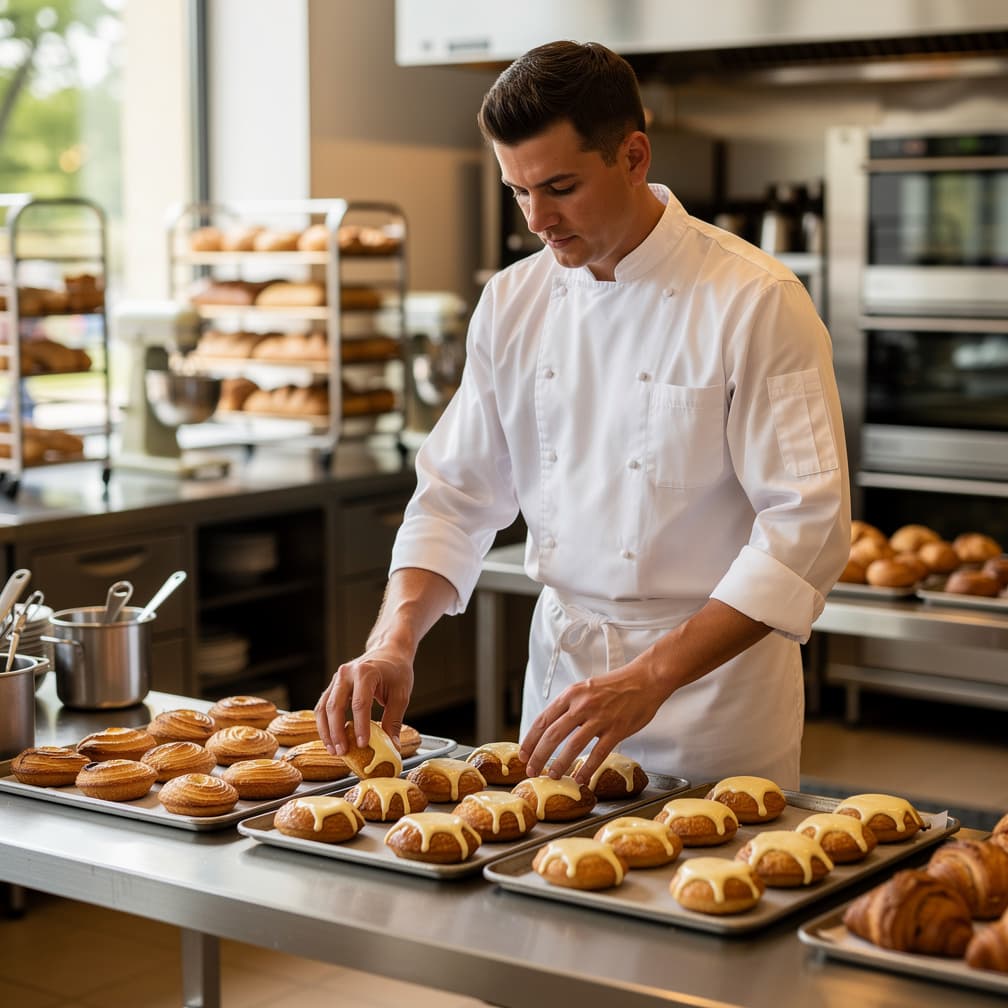

As a bakery in Raleigh, payroll and foot traffic set your premium more than anything you bake. Every hour of counter staff adds Workers Compensation exposure, and every customer who walks past the display case adds slip exposure in an entryway that collects rain and flour in equal measure. Neither is a reason to shrink. Both are reasons to have the numbers straight before a quote gets written, because an underwriter who has to guess will guess against you. Pull twelve months of payroll by job type and a rough daily customer count. Bakery insurance in Raleigh priced off real figures beats a policy priced off a shrug, and the only way to see the spread is to set several participating carriers in North Carolina next to one another.
What Makes Raleigh Different
About 33,000 businesses fill Wake County, and a bakery in a market that size sells to other businesses whether it plans to or not. Offices order trays, hotels order breakfast, event firms order cake, and each of them buys through some kind of procurement process. Procurement means contracts, and contracts mean insurance schedules, notice provisions, and somebody's name added to your policy. That is the real difference density makes: not more competition, but more counterparties with legal departments. It changes the limits you carry, not merely the price you pay for them. A bakery in Raleigh serving only walk-in customers can ignore nearly all of this. The moment one commercial account opens, the paperwork side of the business starts and never quite stops. Decide which business you are in before you pick limits.
Local Risk Factors in Raleigh
Flood water finds a bakery's worst layout: ovens on a slab, a walk-in with its compressor at floor level, and flour stacked on the lowest shelf in the stockroom. A few inches ends production, because the motors, the controls, and the stock all live down there. The part that catches owners in Raleigh is the paperwork rather than the water, since standard commercial property forms exclude flood and a claim after rising water usually goes nowhere. Flood cover is bought separately, through the National Flood Insurance Program or a private equivalent, and it typically carries its own waiting period before it starts. Find out what zone your building sits in within Wake County, then price the separate policy well ahead of the season, because a decision made after a watch is issued is not really a decision.
What Coverage Does a Bakery in Raleigh Need?
General Liability
Landlords, venues, and market organizers ask for this one by name before they let you open or set up a table. It is the line that generally answers when a customer slips near your display case or when a delivery of yours damages somebody else's property. Damage to your own ovens and stock sits elsewhere, and an injured baker is a different policy entirely.
Example: A customer steps off a rain-slick entry mat, lands badly, and hires a lawyer three months later in Raleigh; General Liability can help cover the medical claim and the defense costs behind it.
Commercial Property
Fire, storm damage, vandalism, and theft are the events this line is built around, along with the ovens, mixers, display cases, walk-in, and the stock inside them. Flood and ordinary wear are typically excluded, and equipment that simply fails on its own often needs a breakdown endorsement. Read the stock limit closely, since finished product and ingredients are where bakeries usually come up short.
Example: A hood fire scorches the kitchen and takes the mixer down with it; Commercial Property is generally the line that steps toward the repairs, the replacement, and the ruined stock.
Product Liability
Somebody eats what you baked and gets hurt: an undeclared nut, a foreign object, a batch that makes a family ill. The claim can arrive from a walk-in customer or from the grocer who resold your bread, and wholesale buyers commonly want proof of this coverage before a first delivery. Destroying or recalling the product itself is usually a separate add-on.
Example: A wedding cake goes out with an unlabeled nut filling and a guest ends up in an emergency room; Product Liability may respond to the injury claim and the legal bills after it.
Business Owners Policy
Rather than buying liability and property as two contracts, a Business Owners Policy wraps them into one and usually folds in income protection. For a single-location bakery in Raleigh it is a common starting point and the least paperwork. Package limits are preset, though, so the stock figure and the shutdown period deserve a hard look before you accept the convenience.
Example: Smoke closes the shop for three weeks and two ovens need replacing; a Business Owners Policy might handle the equipment, the ruined stock, and part of the income lost while the doors stayed shut.
Workers Compensation
Burns, cuts, strained backs from fifty-pound flour sacks, and falls on a wet kitchen floor are what this coverage exists for, and it typically pays medical costs and part of lost wages without anyone suing anyone. Whether you must carry it depends on your headcount and your state, and the North Carolina Department of Insurance publishes the current requirements for employers.
Example: A baker reaches into a deck oven before dawn and burns a forearm badly enough for stitches; Workers Compensation typically takes on the treatment and the shifts missed afterward.
How Much Does Bakery Insurance Cost in Raleigh?
Bakery Insurance is a bundle of separate policies, priced separately. The ranges below are typical figures for Raleigh for each line, except workers compensation, which is rated per $100 of payroll; a quote prices each one against your own operations.
| Coverage | Typical range | What moves your price |
|---|---|---|
| General Liability Insurance | $45 - $160 per month | Industry and risk classification, annual revenue, number of employees |
| Commercial Property Insurance | $75 - $260 per month | Building value and construction type, roof age and condition, fire protection class |
| Product Liability Insurance | Varies | Quoted individually based on your operations and limits |
| Business Owners Policy Insurance | $85 - $250 per month | Annual revenue and industry class, building and contents values, square footage and building age |
| Workers Compensation Insurance | $0.75 - $2.74 per $100 of payroll | Employee classification codes, total annual payroll, experience modification rate |
Prices shown are general estimates, not guaranteed rates or quotes. Your actual premium will depend on the insurer, coverage selected, business details, location, claims history, and other underwriting factors. Learn about our pricing methodology.
What Are the Insurance Requirements for a Bakery in Raleigh?
Workers' comp is generally required once you have 3 or more employees. North Carolina generally requires employers to carry workers' compensation at that point. Common exemptions include sole proprietors, partners, and LLC members. Confirm current thresholds with your state's workers' compensation agency before you hire.
Flood damage is typically excluded from standard policies. Standard commercial property and builders-risk-type policies typically exclude flood damage. Flood exposure varies address by address, so check your premises in FEMA's Flood Map Service Center before deciding; if you sit in a mapped flood zone, a separate policy through the National Flood Insurance Program is the usual starting point.
Where to verify licensing and coverage rules. The North Carolina Department of Insurance publishes consumer guidance and current insurance requirements for North Carolina businesses. When a contract or lease demands specific wording, the North Carolina Department of Insurance's guidance is the authoritative place to check.
Get Your Bakery Quote in Raleigh
Compare rates from multiple carriers. Free quotes, no obligation.
Operating in Raleigh
- Deliveries come through the same door customers use in most small shops, which puts a loaded hand truck and a stroller on the same three feet of tile.
- A health inspection can close a kitchen in Raleigh for reasons no policy answers for, so the shutdown risk in this trade is wider than the fire risk alone.
- Cash is still a real part of a bakery's day, and money is usually written at a low sublimit nobody looks at until the till comes up light.
- Wedding and holiday orders concentrate a year of revenue into a few weeks, so a closure in Raleigh during those weeks costs several ordinary months of sales.
How to Buy: Advice for Raleigh Owners
If you sell to anyone who resells, your insurance conversation changes shape. A wholesale account, a grocery shelf, or a caterer puts your product in someone else's hands and someone else's name on the claim. Product Liability is the line that answers there, and buyers will ask for proof of it before the first pallet moves. General Liability alone rarely satisfies that request, which catches owners who assumed one policy handled the whole business. Get your labeling, allergen handling, and batch records in order too, because a carrier will ask and a plaintiff certainly will. Check the North Carolina Department of Insurance's guidance before deciding what documentation to keep on file. Then compare what participating carriers on CPK offer a bakery in Raleigh that sells beyond its own counter.
FAQ
Bakery Insurance in Raleigh: FAQ
Market organizers commonly require proof of coverage and their own name on the certificate before assigning a stall. The request often arrives with a short deadline, which is a problem if you have never issued one. A market stall in Raleigh also changes what you are exposed to, because a folding table on a public walkway is not your controlled floor.
Square footage, annual revenue, payroll by job type, an equipment list with values, your claims history, and a plain description of what you bake and who buys it. Wholesale accounts change the picture, so say so up front. The equipment list is the part owners rush and the part that decides whether a claim rebuilds the kitchen or half of it.
Broken glass, a damaged sign, and graffiti are usually property questions, and many policies treat glass under its own limit or deductible. Read what the sign is scheduled for, since exterior signage is frequently capped at a modest amount unless listed separately. Photograph the storefront now, so the before picture exists when you need it.
The per-occurrence number is what a single incident can draw against. The aggregate is what every incident in one policy year can draw between them, added together. A bakery with a busy counter can grind through an aggregate on a handful of slips and burns without ever seeing one large claim, and it does not refill until renewal. Ask what yours is, and whether defense costs come out of it.
Actual cash value subtracts depreciation, and on a ten-year-old deck oven that can be most of its worth. Replacement cost aims at what a new one costs today and usually raises the premium a little. Given the lead times on commercial baking equipment, the valuation question tends to matter more than the monthly difference. Ask which one each quote in North Carolina assumed.
Landlords commonly ask for proof of coverage as a condition of handing over keys, and the certificate has to name them the way the lease specifies. The policy usually has to exist before the space does. A landlord in Raleigh can hold occupancy over a missing endorsement, so read the insurance clause the week the lease draft arrives, not the week you move in.
Sources
- 1.U.S. Census Bureau, County Business Patterns (2022), Wake County(Wake County has about 33,000 business establishments.)
- 2.North Carolina Department of Insurance(North Carolina Department of Insurance publishes consumer guidance for insurance buyers.)
- 3.FEMA / FloodSmart(Flood coverage is typically purchased separately; FEMA administers the National Flood Insurance Program.)


